A Tiny Miracle
My gift to you: a holiday oratorio from 25 years ago

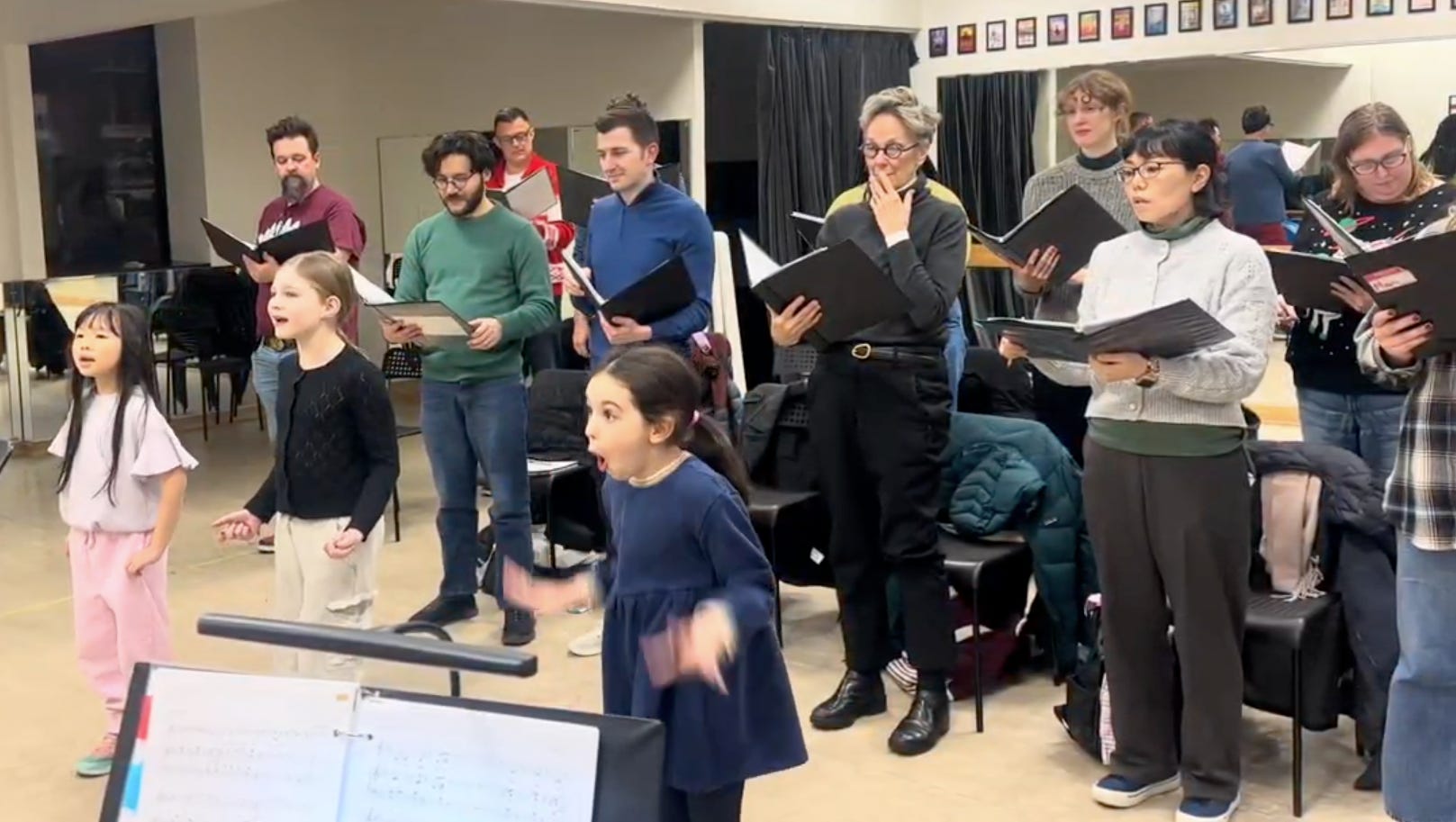
A trio of seven-year-olds stand at the front of Voices of Music Theater Philly, waiting for their cue. Behind them, fifteen adult voices are poised to join in. I raise my hands, and we begin: “Something very strange is happening to me / I’ve begun to change quite imperceptibly...” The children launch into “I’m growing, I’m growing, I’m growing!” with that specific mix of concentration and glee that only happens when kids get to shout on purpose.
I wrote this song twenty-five years ago, sitting in my basement office after attending a holiday pageant at the First Unitarian Church of Wilmington. These pageants are sincere efforts—community members and Sunday School kids working hard to create something meaningful for the season. But as a composer and theater professional, I found myself restless, aware of how the conventions of the form could be elevated. I turned to D’Arcy that evening and said, “One of these days I’m going to write a Christmas pageant I can sit through.” She likes to tell people that I then quietly disappeared into my workspace and emerged a few months later with a complete draft of A Tiny Miracle. Now here I am, not just sitting through it, but leading it—watching these children embody a question the Little Tree asks throughout the piece: what kind of miracle am I meant to be?
Most of my Substack essays analyze other people’s work—productions I’ve seen, pedagogical questions I’m wrestling with, historical threads I’m trying to preserve. Today I want to do something different: share one of my own pieces with you. Consider it a small Christmas present, a chance to experience A Tiny Miracle firsthand through the original demo recording we made in 1999. The story is simple enough for children, but like all good parables, it asks questions that resonate at any age. What if you’re not growing the way you expected? What if your purpose takes longer to reveal itself than you’d hoped? And what does it mean to keep faith while you’re waiting?
The source material came to me through my dad. He’d met author Richard Wainwright at a book signing and brought home a copy of A Tiny Miracle for my infant son, Alex. The book went into heavy bedtime reading rotation during the holiday season, and I found myself returning to it long after Alex had moved on to other stories. It seemed like such a good parable: the little tree, so full of love, who feels like a misfit because she hasn’t grown big like the other trees on the farm. “What’s wrong with me?” she plaintively asks the Wise Oak, who reassures her, “It takes time to see what kind of miracle you were meant to be.” That line stayed with me—both as a father reading to his son and as a theater artist thinking about meaning-making and purpose.
Richard Wainwright and I corresponded by mail—this was the late 1990s—and he graciously gave permission for me to adapt his story. After I recorded the demo, he was so pleased with it that he produced his own CD combining my soundtrack with an audiobook presentation of his text, which he sold on his website. We maintained a friendly connection over the years, but we didn’t meet face-to-face until around 2015, when I discovered he had a winter home in Palm Coast, Florida, not far from where my mother and her husband had settled. I arranged to drop by.
He was lovely and gracious, exactly the kind of person you’d hope had written A Tiny Miracle. But it was also immediately clear that the main work of his life at that moment was caring for his wife as they both navigated her gentle decline into dementia. Here was a man who had lived according to three simple mottos: help the other fellow, press on regardless, and do random acts of kindness. His vocations had spanned teacher, coach, headmaster, entrepreneur, and award-winning author—twelve books in all, each focusing on family values and compassion as ways to cope with life’s challenges. Now he was living those values in the most intimate and demanding way possible, attending to his wife with patient devotion. The Wise Oak’s counsel seemed to apply to him too: it takes time to see what kind of miracle you were meant to be.
The Story Begins
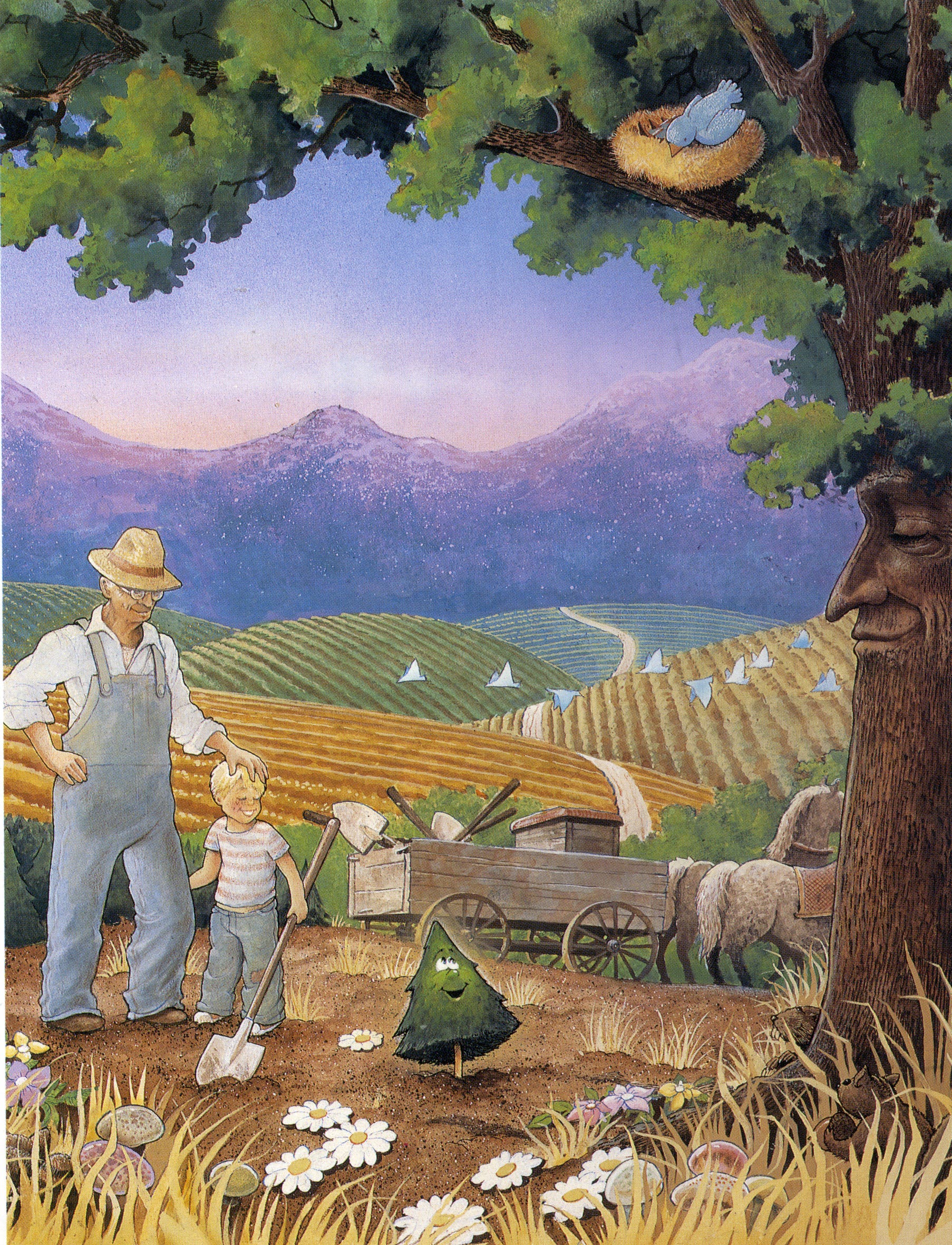
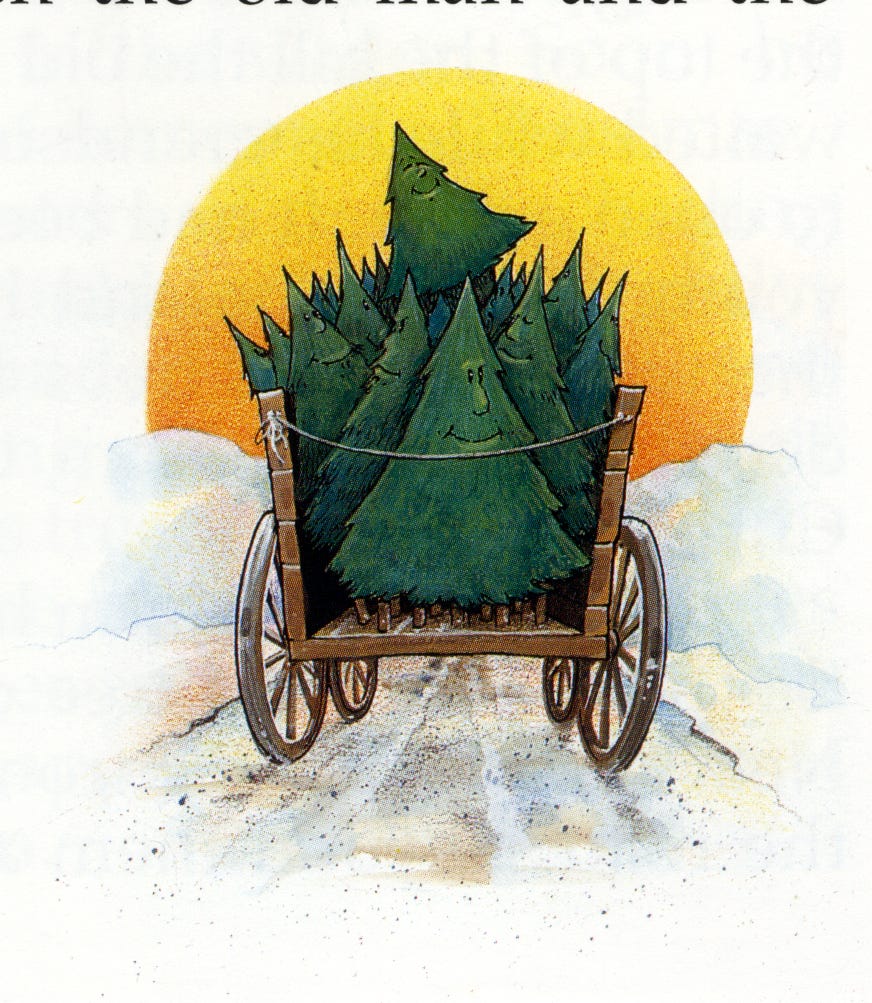
Wainwright’s story begins in a peaceful valley where the Wise Oak—the oldest tree in the forest—observes everything from her lofty vantage point. “You see a lot when you’re a tree, ‘specially one as old as me,” she sings in the opening number, accompanied by a wordless vocal melody that establishes the gentle, unhurried world we’re entering. But that tranquility is about to be disrupted. The Wise Oak hears unfamiliar sounds—horses, wagon wheels, human voices. Soon two strong horses pulling a wagon come into view. An old man holds the reins while a small boy sits close beside him, and the wagon bed is filled with tiny Christmas tree seedlings.
All day Grandfather plants the seedlings while young Timmy watches. As afternoon sun leaves the valley, the old man finishes his work, leaning wearily on his shovel. But the boy spots one more seedling in the wagon—”Awful tiny one, that,” Grandfather observes doubtfully. Timmy insists it deserves to grow just like the others, and Grandfather relents. The boy takes the big shovel and struggles to dig a hole right under the branches of that wise old oak. When the tiny tree is finally tucked into the earth, Grandfather sings a song that establishes the central metaphor of the entire piece: “It isn’t difficult to plant a tree / It’s just a little thing as you can see... And every miracle begins with something small.”
I’m Growing
The Little Tree wakes up to find herself planted under the giant oak’s shadow, separated from the other seedlings. She tries to call out to them, but they’re too far away to hear clearly—and besides, they find it amusing that this tiny tree ended up in such an odd spot. The Wise Oak welcomes her and explains that growing is simply what trees do. It’s their nature. And then the Little Tree feels it: “Something very strange is happening to me / I’ve begun to change quite imperceptibly / Every branch is twitching, every cell is itching / This is so bewitching, can it really be?”
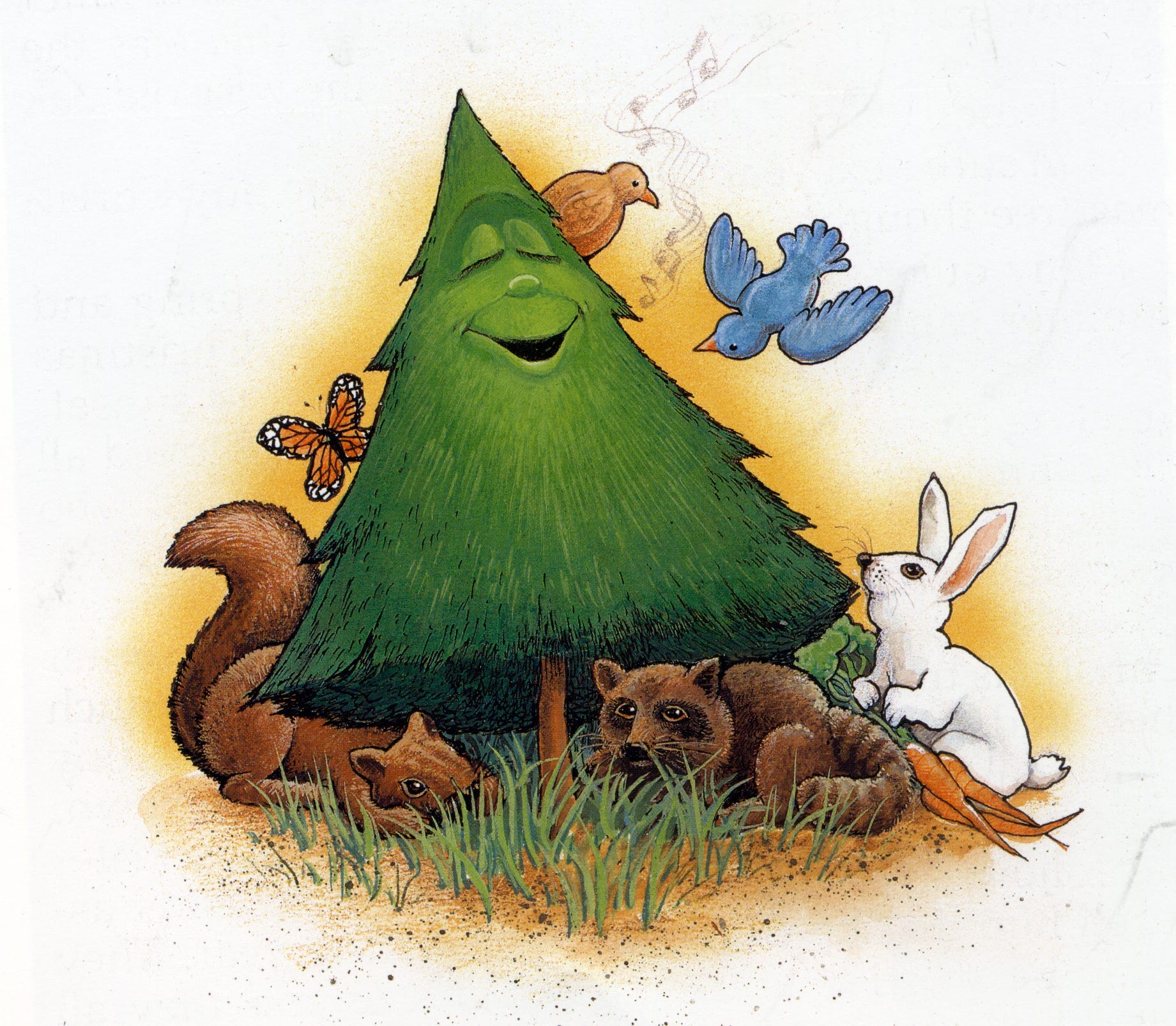
What follows is pure theatrical joy. “I’m Growing” is the Little Tree’s ecstatic discovery of her own aliveness—needles sprouting, branches reaching, the whole sensory rush of growth flooding through her. The chorus joins in as all the evergreens in the valley respond to spring’s arrival. There’s a section where forest creatures (squirrels, foxes, chickadees) gather to play in her shade, and even though she’s planted on the west side of the oak where shadow covers her most of the day, she’s grateful for those few precious minutes of sunshine. Then the music shifts into a Latin jazz rhythm as spring breezes and Mother Nature’s rhythms rock her to her roots. The ensemble builds to a big finish: “I’m growing! Just watch me grow!”
This is the number Voices of Music Theater Philly will perform on December 18th, and it’s easy to hear why—it gives young performers a chance to embody pure enthusiasm while the adult chorus provides sophisticated harmonic support.
Have a Little Faith
But as spring gives way to summer and summer fades into autumn, the Little Tree makes a devastating discovery. The other Christmas trees call out to each other: “Look at me! I’m six inches taller!” “I’m five inches fuller!” She realizes with growing alarm that while everyone else has been shooting up, she’s remained exactly the same size. “Something very strange has happened here, I see / Every tree is growing—every one but me!” She’s been so full of joy, so certain she was part of the same miracle everyone else was experiencing. What went wrong?
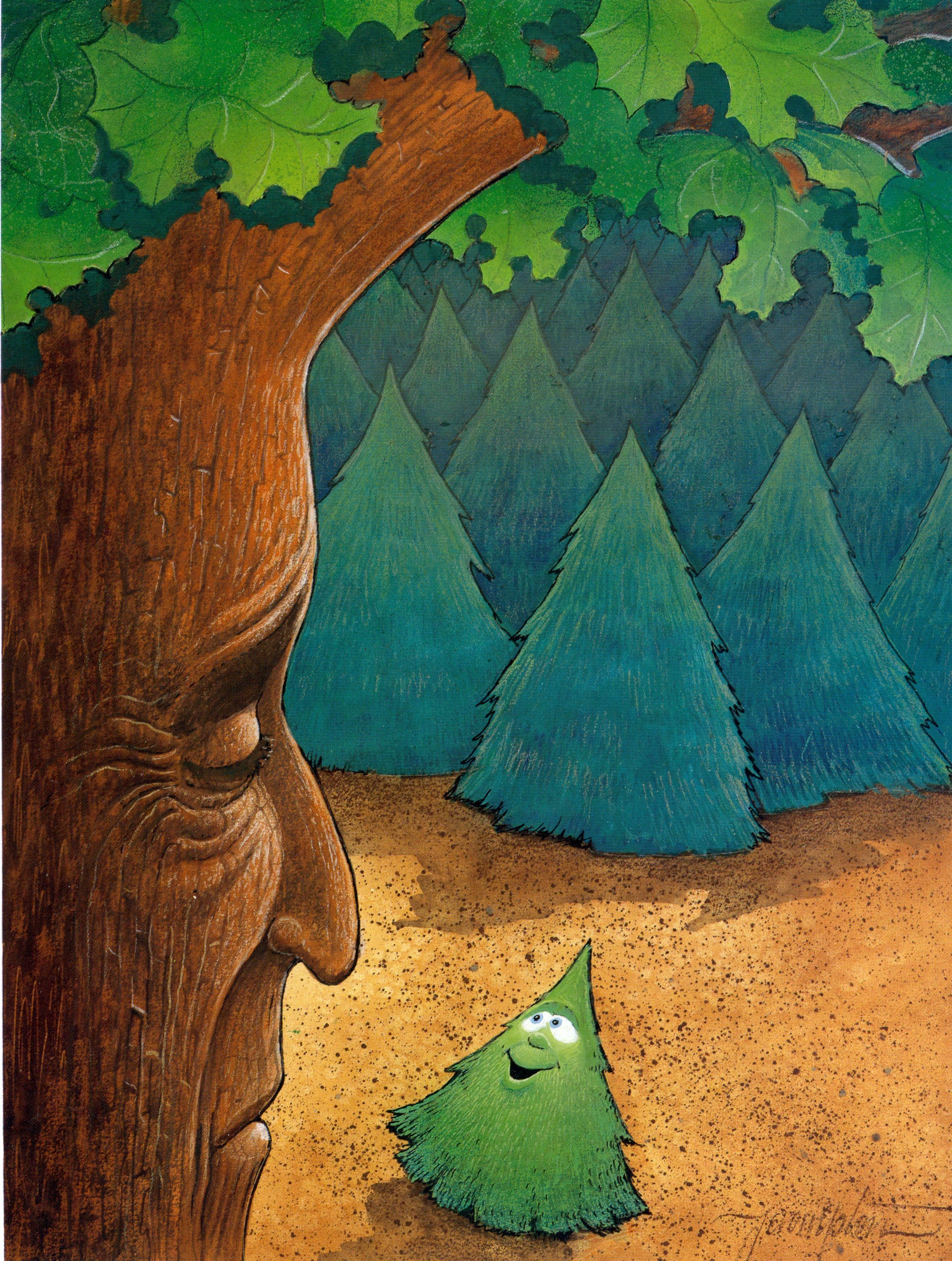
The Little Tree turns to the Wise Oak in confusion: “Am I doing something wrong? Why are the other trees so much bigger than me?” And here the wise old oak offers the counsel that sits at the philosophical heart of the entire piece:
“Have a little faith / There’s nothing lives in vain / Your purpose will be plain in time.”
It’s a gorgeous song, part gospel, part jazz ballad, sung in the demo by Joilet Harris with a warmth that makes you believe everything will be okay. Joy was one of the most respected performers in Philadelphia’s theater community—an actress and singer who could command a stage with both power and tenderness. Born in Germantown, she’d been singing in church since age three, and that gospel foundation infused everything she touched. She would go on to win a Barrymore Award in 2007 for the title role in Caroline, or Change, appear in HBO’s The Wire, sing with Patti LaBelle, tour Europe with the Harlem Gospel Choir, and become what colleagues called “Philadelphia’s Treasure.” We got to work together several times over the years, and I wrote the dual role of Wise Oak and Nurse specifically for her voice and presence. The throughline makes dramatic sense—the tree’s guide becomes the hospital’s caregiver—but it also captured something essential about Joy herself: wisdom paired with compassion, strength with gentleness.
In December 2021, twenty-two years after we recorded A Tiny Miracle, Joy joined our Zoom reunion to listen to the work again. She’d recently married William Lawton and was planning a new chapter. Less than a year later, on October 14, 2022, she died at age 64 from complications of non-Hodgkin’s lymphoma. The Philadelphia theater community mourned deeply—tributes poured in from the Arden, the Walnut Street Theatre, People’s Light, and beyond, all speaking of her powerhouse voice, her generosity, the way she lifted every room and production she entered. Listening now to her sing “Have a Little Faith,” knowing she was gone so soon after hearing it herself one last time, I hear not just the beauty of her instrument but the embodiment of the song’s message: faith in the face of uncertainty, trust that purpose reveals itself in time.
The Wise Oak reminds the Little Tree that there are lots of ways to grow, that little drops of rain may not know why they fall but they still fill the sea eventually, that little acorns grow to be majestic oaks. “Each of us is a kind of miracle / A precious gift to share / Even you are a tiny miracle / And it takes time to see / What kind of miracle you were meant to be.”
The Little Tree accepts this wisdom, somewhat placated. She’s sure she’ll grow much faster next year.
Whispering Trees
Seven summers pass. The Wise Oak’s leaves turn orange and fall to the ground “with a quiet sense of anticipation,” as if the trees know the grower will be returning soon. Snow blankets the valley. The chirping of winter birds and the anxious murmuring of the Christmas trees are the only sounds to be heard.

“Whispering Trees” is one of the most beautiful numbers in the score—a choral meditation on waiting and faith. The adult voices create a hushed, almost reverent atmosphere: “Whispering trees / Trembling in the moonlight / Stirred by the breeze / Quietly they sing.” Underneath the winter snows, deep in the earth, there’s a special magic ready for birth at the touch of spring. The gift of life is evergreen and growing in these whispering trees.
The Wise Oak adds a soulful countermelody over the chorus, and there’s a poignancy to this moment that the storyteller makes explicit: “The old oak sadly looked down at its little friend, knowing it wouldn’t be long before the tiny Christmas tree would be heart-broken.” The trees have all been growing toward this harvest moment. But the Little Tree, planted in the shadow, receiving only a few minutes of sunshine each day, hasn’t received enough light and water to grow much bigger. She’s healthy, yes. But she’s still tiny. And she doesn’t know it yet.
Make Me Beautiful
In the morning, the sound of horses’ hoofs padding quietly through the snow announces the return of Grandfather and his grandson—though the boy has clearly done some growing himself in those seven years. Each tree shakes its branches and stands as tall and straight as possible, knowing this is the day they’ve all been waiting for. But the Little Tree is buried under a pile of snow she can’t shake off. “I’m here, I’m here!” she calls desperately. The Wise Oak knows they’ll never see her under all that snow.
But the grandson spots her, brushes off the snow, and insists she still deserves a chance. Grandfather is doubtful—”Got a nice shape to it. Maybe the man from the city will be willing to buy it”—but he lets the boy cut her down anyway. Soon Wally, the tree lot man from the city, arrives to load up his truck. When he spots the Little Tree, he grins: “This little tree’s a beaut!” and hands the grandson some coins. The trees are loaded onto the truck, and they’re off to the city.
Enter the Pretty Tree—a role I wrote specifically to showcase the talents of my wife, D’Arcy Webb. She gets the showstopper “Make Me Beautiful!” The Pretty Tree is fresh off the farm, a bundle of charm, ready for her big city debut. She’s been waiting years to be decorated, and she knows exactly what she wants: bright lights and tinsel, garlands and beads, berries and popcorn, a star on her highest bough. The song is pure musical theater sass—part vaudeville, part Christmas spectacular, with the kind of belt-mix swagger D’Arcy knows how to deliver.
The Pretty Tree isn’t just excited; she’s ready. She’s got the height, the shape, the confidence. And she makes sure everyone knows it. The other trees join in her fantasy of being decked out for Christmas, strings of peppermint candies and bubbling lights, satin and lace. The Little Tree wriggles with excitement too—so much so that she jostles the Grumpy Tree, who snarls at her: “You’re not big enough to have toys and presents under your branches, and you’re not strong enough to hold up lots of decorations. Nobody will want you.”
But the Pretty Tree shushes him, and soon they’re pulling into the city, all the trees singing together: “We’re bringing Christmas to the city!”
The Perfect Tree
Wally pulls into the city and sets up his tree lot, carefully arranging his inventory around the space. But what to do with the Little Tree? He climbs up a short ladder and places her on a high shelf overlooking the lot. “I’ve got the perfect place for you, little guy!” From this vantage point, she can see everything—and she watches with growing hope as Wally hangs price tags from the branches of all her bigger brothers and sisters.
With only ten days until Christmas, it’s time for customers. And they arrive in force—each with their own very specific vision of perfection.
“The Perfect Tree” is a massive ensemble number that brings together multiple soloists, a children’s chorus singing carols, and the adult chorus backing it all up. Mr. Douglas insists he must have a Douglas Fir—it’s traditional in his family—and Wally cheerfully sells him a pine instead. A mother arrives with demanding children: “None of these trees is nearly big enough! / Santa is going to bring a lot of stuff! / Where is he going to put it all? / We need a tree that’s eight feet tall!” Miss Martin wants something slender and spare, just like the photograph she’s clipped from a magazine—”Martha Stewart has one, and Martha ought to know!” And poor Miss Claritin, dramatically clutching her chest, can only manage: “Have you something hypoallergenic? / I can’t buy trees that make me sneeze.”
All these competing visions of the perfect tree—traditional, huge, skinny, hypoallergenic—pile up in glorious counterpoint while carolers weave through singing “Deck the Halls” and “Gloria in Excelsis Deo.” It’s organized chaos, joyful and exhausting, and at the end everyone exits satisfied, their perfect trees in tow. The Little Tree waves goodbye to each departing friend, still hopeful: “Have a wonderful Christmas!”
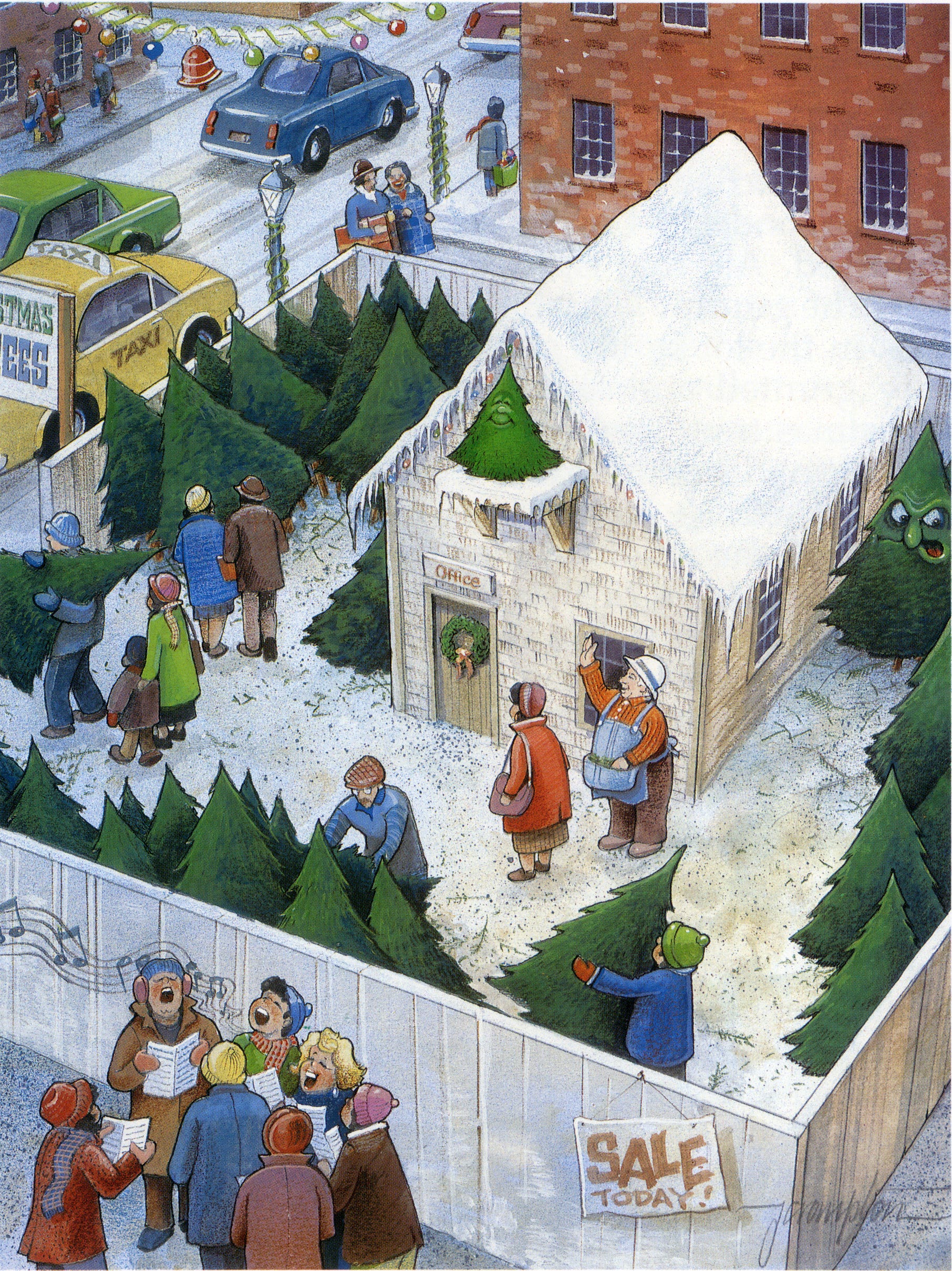
But day after day passes, and nobody looks up at that high shelf where she waits.
Have a Little Christmas On Me
On Christmas Eve, only one tree remains on the lot with the Little Tree—and it’s the Grumpy Tree who’d been so mean to her on the truck. He’s still confident: “I know I’ll be picked today, just wait and see. You’ll be spending Christmas all by yourself.”
Then a poorly dressed man shuffles into the lot. He hesitates in front of that last remaining tree, examining the price tag, then pulls out his wallet and peers into it for a long, sad moment before starting to walk away. Wally stops him with a gesture: “Wait. I think I understand.”
“Have A Little Christmas On Me” is one of the most affecting songs in the score—a bluesy, warm-hearted number about recognizing someone else’s struggle because you’ve been there yourself. It’s performed here by Jeff Murphy, who was my student at the University of Delaware in the 1980s and for whom I’d written roles in two previous
musicals. Jeff is a rock and roll guy with a natural knack for colorful stage characters, and Wally is right in his wheelhouse—working-class, big-hearted, unpretentious. He sings: “I been there myself and I know that it can be tough / The money in your pocket never seems to be enough / But just for today, hey, what do you say / You have a little Christmas on me?”
It’s the kind of generosity that doesn’t make a show of itself. Wally adds mistletoe and holly, slips the man some extra money for presents, and sends him off: “Maybe next year you’ll help some other needy family / Who needs a little generosity.” The poor man picks up the Grumpy Tree and exits, grateful and smiling.
Wally locks up the lot and heads home to his own family. And for the first time in her life, the Little Tree is completely alone on Christmas Eve. She’s still up on that high shelf, forgotten. The Grumpy Tree was right.
Alone
And now comes the emotional heart of the piece. The Little Tree, alone on Christmas Eve, realizes the truth she’s been trying to avoid. She begins to cry—and she sings “Alone.”
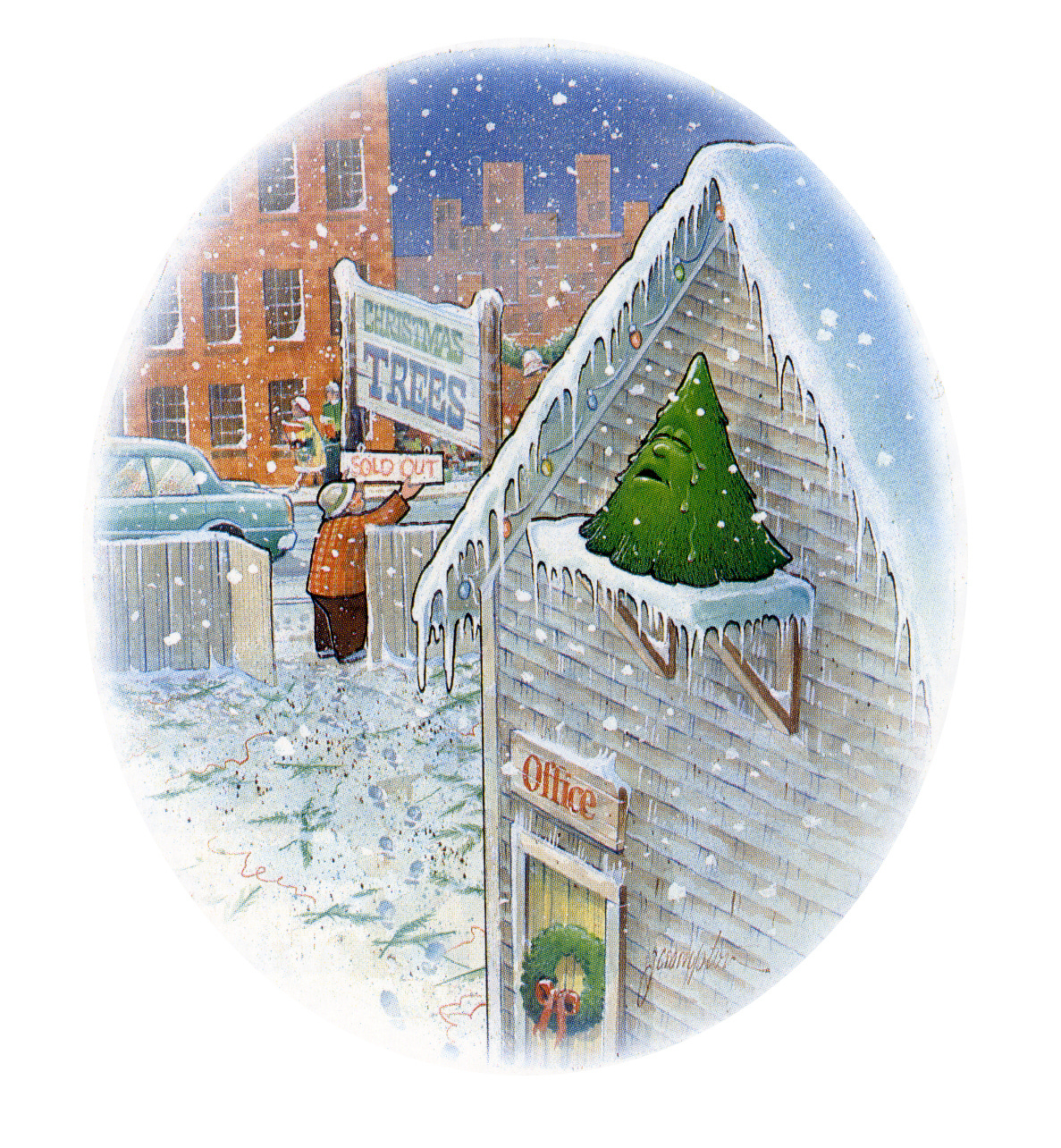
“It’s Christmas Eve and I’m alone / And it’s an awful sort of feeling / Like none that I’ve known.” Her hopes had been so high. She’d come so far, believed so completely that her moment would come. “Can it be true / There’s no one who will buy?”
But then the song shifts from self-pity to something deeper. The Little Tree understands that her size isn’t the real measure of what she has to offer: “I’m small, they see I’m little and that’s all / But if you measure me in love / I’m a hundred feet tall!” The love she brings is as big as all outdoors—but unless someone makes her theirs, that love remains unknown. And she remains alone.
Anna Klate sang this in the demo as a teenager, and when we gathered on Zoom twenty years later, she reflected on hearing it again: “As now a 40 plus year old person, instead of a teenager singing that... Man, that is a sad song about that. No man, poor little tree.” She’d sung it beautifully at seventeen, but she understood it at forty—what it means to have something precious to offer and wonder if anyone will ever see it.
It’s that kind of song. Simple on the surface, deeply moving with carefuly listening.
The Rescue
Just when all seems lost, a young man rushes into the tree lot and literally bumps into Wally, knocking them both to the ground. “I’m terribly sorry, but this is an emergency. I only have a few minutes and I’ve got to buy a Christmas tree for my wife!” But Wally’s sold out—everything’s gone. The man looks around desperately: “Wait! What about that tree on the roof of your shed?”
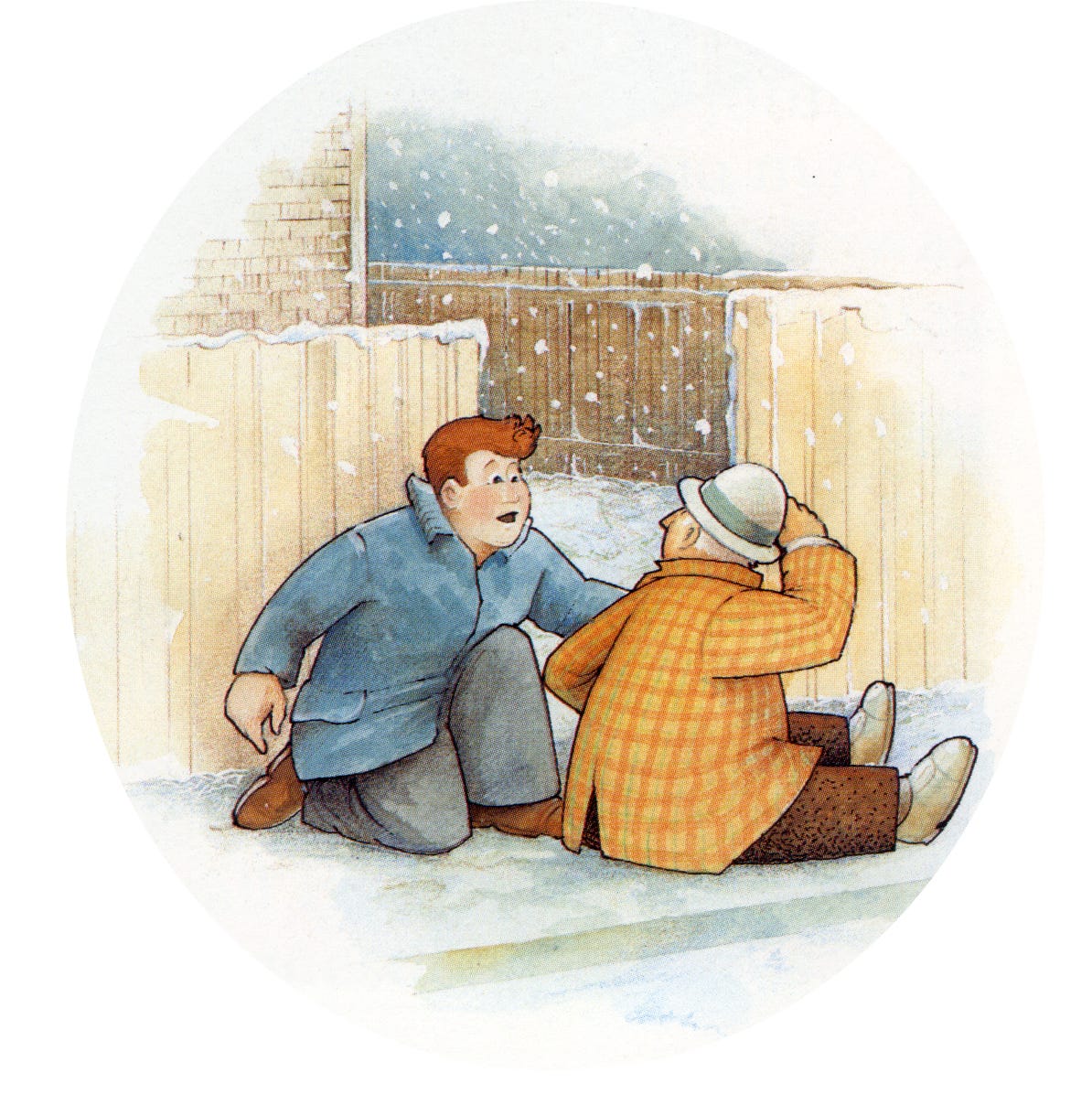
Wally had completely forgotten about the Little Tree. “Tell you what—if you climb up there and take it down, it’s yours.” Before the Little Tree can even shake the tears off her branches, Mr. Johnson has climbed the ladder, grabbed her, and is running down the street. “Taxi!” he shouts. “To the hospital, as fast as possible!”
The hospital? Why is he taking a Christmas tree to a hospital?
Inside the building, all is quiet as Mr. Johnson hurries down a long corridor toward a nurse—played, significantly, by the same actress who sang the Wise Oak earlier in the show. She tells him he’d better hurry; he doesn’t want to miss the excitement. He places the Little Tree on a table in his wife’s room and follows the nurse down the hall.
And then we hear “Bells at Midnight.”
This is a showpiece for the chorus—pure choral craft. It begins with a simple, almost austere theme: “On this longest night of all / Through the darkness hear them call / Bells proclaim the news to men.” The theme repeats as a two-part canon, then expands into a more complex four-part canon, the intricate weaving of voices suggesting both the multiplicity of church bells across the city and something larger—the convergence of individual miracles into a collective moment of grace. Near the end, the music quotes a phrase from “Have A Little Faith,” and just as the bells fade into silence, another sound is heard: a baby’s cry, weak at first, then growing louder and stronger.
The Finale
The nurse wheels Mrs. Johnson into the room, and she gasps with delight: “Oh, look at this sweet little tree. Did my husband bring that?” Then Mr. Johnson enters, beaming, carrying a tiny baby bundled in a small blue blanket. Mrs. Johnson whispers, “Honey, this little tree is just perfect.” He gazes at the baby in his arms: “So’s this little guy here. Just perfect.”

The new parents sing a gentle reprise of the opening song: “It’s like a miracle / We have a son / Our tiny family has grown by one / This precious gift has been entrusted to our care / And he’ll grow fine and fair and full of grace / Within his parents’ strong embrace.”
And then the Little Tree understands. This is her miracle. Not to stand in a grand living room surrounded by expensive presents. Not to be decorated with bubbling lights and silver tinsel. But to be present for the most intimate moment—a family’s beginning, a child’s first hours of life. She joins the parents in song: “So let us celebrate on Christmas morn / A tiny miracle: a child is born / A child who, just like me, will grow to be / Magnificent, strong and...” (she admits sheepishly) “Well, maybe a little taller than me.”
The storyteller tells us that in a few hours Mr. Johnson returns with family and friends, and everyone agrees that not only does Mrs. Johnson have a lovely baby, but also the most beautiful Christmas tree they had ever seen.
The nurse—once again the Wise Oak—returns to sing the wisdom she’d offered at the beginning: “A single flake of snow can start an avalanche / One root alone can split a stone in two / And little acorns grow to be majestic oaks eventually / Although you may be small, there’s big things you can do.”
The full company joins for the final statement of the central theme: “Each of us is a kind of miracle / A precious gift to share / Even you are a tiny miracle / And it takes time to see / What kind of miracle you are meant to be.”
The piece ends with the storyteller’s benediction: “In this dark and frozen season, let us celebrate the miracle of faith.”
Waiting for the Miracle
The journey of A Tiny Miracle has turned out to mirror the Little Tree’s story in ways I didn’t anticipate when I wrote it. Every miracle begins with something small, and mine had a sweet debut at the First Unitarian Church in Wilmington, with an additional performance at the University of the Arts in December 1999. We made the CD early in 2000 with many of the original cast recreating their roles in the studio.
For twenty-four years, the piece waited. My sons grew into adults. I started reading Richard Wainwright’s book to my grandchildren. And then in 2023, the Unitarian Universalists of Southern Delaware in Lewes decided to produce it as their Christmas pageant. I was singing in the choir there at the time, and music director Julie Keefer loved the piece enough to take it on. Now, in December 2024, Voices of Music Theater Philly is performing “I’m Growing”—and I’m the one leading the rehearsal.
The Little Tree spent many years planted in the shadow before anyone recognized what she had to offer. I’m learning something about the wisdom the Wise Oak offers her: it takes time. Not every work finds its audience immediately. Some need to wait for the right moment, the right community, the right confluence of need and readiness. Like the Little Tree, A Tiny Miracle may still be discovering what kind of miracle it was meant to be.
Postscript: The complete script and score for A Tiny Miracle is available on the New Play Exchange at newplayexchange.org/plays/904371/tiny-miracle. If you’re looking for a multigenerational holiday musical for your community, church, or school, I’d love to hear from you.