About the Dark Times

In the dark times
Will there also be singing?
Yes, there will also be singing.
About the dark times.
— Bertolt Brecht, motto to the Svendborg Poems, 1939 (trans. John Willett)
I. In the Dark Times
Recently, I went to see some friends perform in a proudly amateur production of Urinetown. Amateur in the original sense — from the Latin amator, lover — performed by Music Theatre Philly’s MTP Players, a program for “grown-up theater kids” who didn’t pursue theater professionally but never lost their love for it. The room was full of their friends and family. The energy was warm and celebratory. And the show they were cheering tells a story about the end of the world.
Urinetown is a musical about a dystopian future in which a severe water shortage has made private toilets illegal. A corporation called Urine Good Company controls all public amenities and charges fees the poor cannot afford. When a young idealist named Bobby Strong leads a revolution, he wins — and then loses everything anyway, because it turns out the oligarchs were right about one thing: the water really is running out. In the final moments, the surviving characters turn to the audience and shout “Hail Malthus!” — invoking the eighteenth-century economist who predicted that unchecked population growth would outpace the earth’s resources, with catastrophic results. The show told you this was coming. It told you in the first five minutes, and still the room cheered.
I found myself wondering: do they know what they’re cheering for?
I don’t mean that as a criticism. The people in that room were doing exactly what theater asks of us — surrendering to the experience, riding the energy, celebrating the performers they loved. And Urinetown is genuinely, brilliantly funny. It earns its cheers. But sitting in that warm room, watching those joyful faces, I felt the particular chill this show has always given me: a suspicion that its darkness is so skillfully wrapped in comedy and self-awareness that audiences can receive it as pure entertainment and go home without ever unwrapping it.
Which may be precisely the point — and which connects Urinetown to a tradition nearly a century old, one that has always understood something more comfortable shows do not: that the most subversive thing you can do in a theater is make people laugh at their own predicament.
Bertolt Brecht wrote the motto to his Svendborg Poems in exile in Denmark in 1939, as Europe was disappearing into darkness:
In the dark times / Will there also be singing? / Yes, there will also be singing. / About the dark times.
He wasn’t offering consolation. He was making a promise, and a demand: that the singing would not be escape, would not be denial, but would be about the dark times — which is a harder and more honest thing.
I have spent most of my professional life inside that tradition. Lately — this year, this American moment — it feels less like a tradition than a lifeline.
It started with a record album. I was in high school in West Chester, Pennsylvania, a quiet county seat about twenty-five miles west of Philadelphia, and I ran with a brainy crowd. One of my best friends was an army brat who had lived in Germany; another was a classical violinist with whom I spent long afternoons in the music library at West Chester University, the college in our hometown. It was there that I first encountered a recording of Die Dreigroschenoper — The Threepenny Opera — by Bertolt Brecht and Kurt Weill. Sung in German, the same language I was studying with Herr Timothy in high school. The album cover was striking, and the music coming through the speakers was like nothing I had heard before: grating, astringent, deliberately ugly in places, and utterly riveting. I didn’t have the vocabulary for what it was doing to me. I just knew that a door had opened.
The times had something to do with it. This was the early 1970s — an untrustworthy president, an unpopular war, a spirit of dissent among my peers. I lived in a sheltered middle-class cocoon; the draft ended before I was old enough to be eligible, and the upheavals of the era reached me more as atmosphere than as direct experience. But something was wrong with the world the adults had built, and here were a composer and a playwright saying so — loudly, ferociously, refusing to make it comfortable. I was also listening to Frank Zappa and discovering Stravinsky’s L’Histoire du Soldat, drawn to the same quality in all of them: popular forms stripped down until the bones showed, the prettiness removed, something more honest left in its place.
As a college senior at the University of Delaware, I finally saw a production of Threepenny — not in it, not involved, just watching from the sidelines — and was so transfixed that when I applied to graduate school for directing, part of my application was a proposal to direct it myself. Hopelessly naive, I now recognize. But the impulse was real.
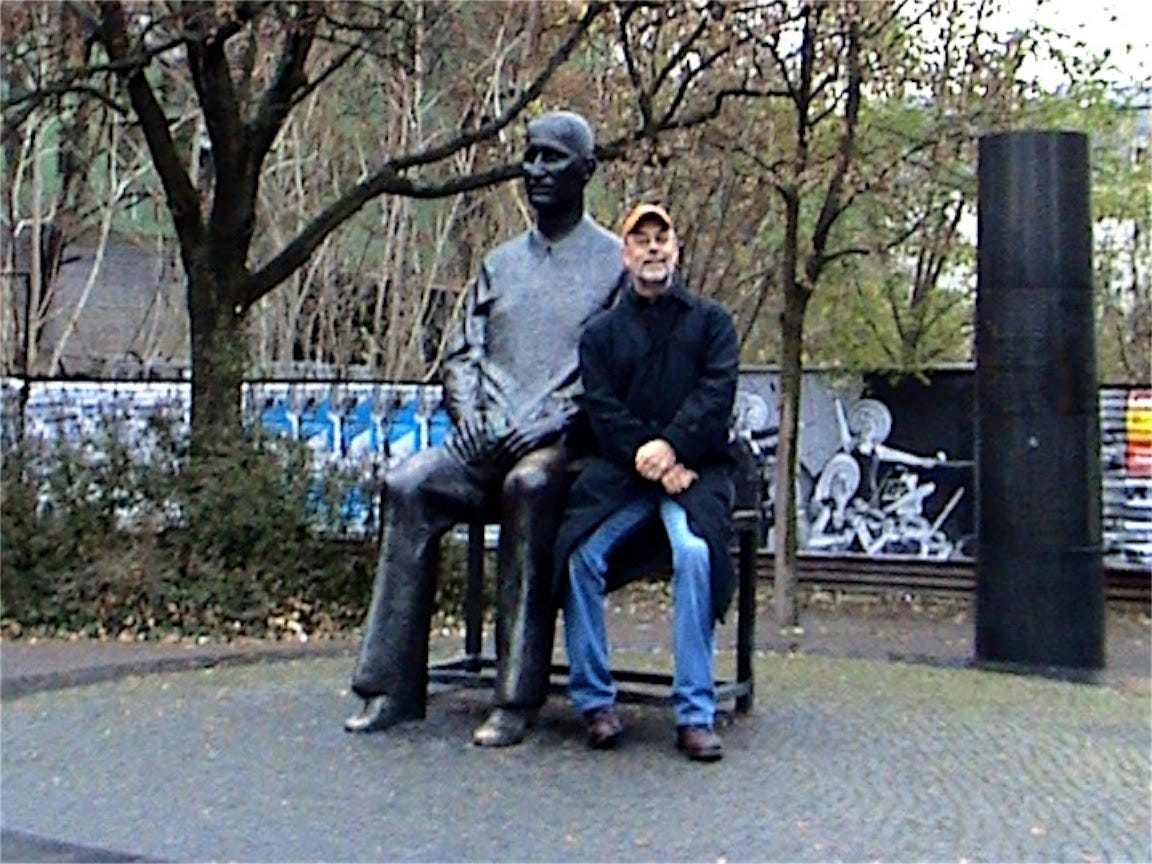
I didn’t get into Yale. I went to Carnegie Mellon instead, which turned out to be exactly right. But Threepenny stayed with me — through graduate school, through decades of teaching and directing, all the way to Berlin, where I had my picture taken with a statue of Brecht in the memorial outside the Theater am Schiffbauerdamm, the house where it all began.
What it set in motion was a lineage — a line of descent running from Weimar Berlin in 1928 to Roosevelt’s New York in 1937 to the New York International Fringe Festival in 1999, and then, improbably, to Broadway. Three works, three moments of political crisis, one argument: that musical theater can tell the truth about power and complicity and the systems we live inside, and make you laugh while it does.
The Threepenny Opera. The Cradle Will Rock. Urinetown.
In the dark times, there will be singing. About the dark times.
II. Will There Also Be Singing?
The question the motto asks is not rhetorical; it carries genuine doubt. In truly dark times — Weimar collapsing, fascism rising, exile closing in — the case for singing is not obvious. Art can feel like a luxury, or worse, a distraction. The serious response to catastrophe might be action, not theater.
Brecht refuses that binary. The singing is not instead of action, not consolation, not escape; it is about the dark times, which makes it a form of witness. Each of the three works in this lineage embodies that witness differently, and each arrived when the case for such singing had to be made against real resistance.
The Threepenny Opera premiered at the Theater am Schiffbauerdamm on August 31, 1928. By legend it was expected to fail — the production chaotic, the rehearsals fractious, Brecht and Weill barely speaking by opening night. Instead it became the sensation of Weimar Berlin, running for hundreds of performances and spreading across Europe within months. But the success was not simple. What audiences cheered was a work that picked their pockets even as they applauded — a musical that used the conventions of light entertainment to expose the criminal foundations of respectable society. Macheath the charming gangster and the bourgeois businessmen who prosecute him are, Brecht insists, indistinguishable: law and crime, the same enterprise, differently licensed.
Weill’s music makes the argument before the brain can catch up. The Kanonensong — the “Cannon Song,” or in Marc Blitzstein’s translation, the one about chopping people to bits because we like our hamburgers raw — lands like a physical blow, marrying the rhythms of military march and music hall to something genuinely ferocious. Mark Hollmann, the composer of Urinetown, heard it as a teenager and felt a door open in his imagination. So did I, in that West Chester music library, the record turning, the sound unlike anything I’d met in a musical before.
The Cradle Will Rock had a different kind of premiere, one that became legend before the curtain rose. Marc Blitzstein’s pro-union musical, inspired by Brecht and produced by the Federal Theatre Project, was shut down by an act of Congress on the eve of its opening in June 1937. What happened next has passed into theatrical myth: the company and their audience walked twenty blocks through Manhattan to an empty theater, where Blitzstein sat alone at an upright piano and played and sang the entire score himself, while the cast — barred by Equity from the stage — rose one by one from their seats in the house and sang their parts from the audience.
It was an electrifying act of defiance, and it made Cradle something more than a musical: a symbol of what political art looks like when the people in power take it seriously enough to try to stop it.
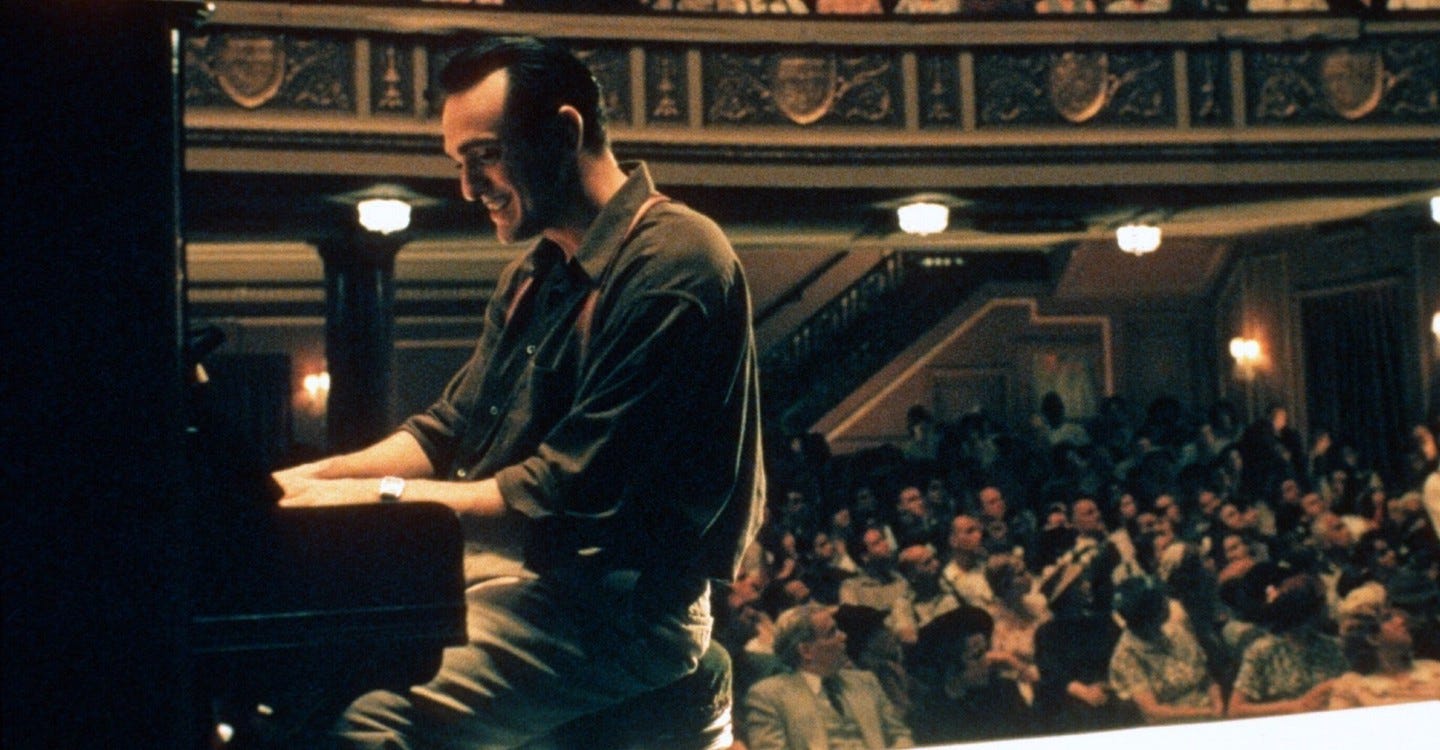
I saw the Encores! production of Cradle in New York and later produced it at the University of the Arts. Before either, Tim Robbins’s 1999 film Cradle Will Rock had already made the case for me — capturing the struggles Blitzstein and his collaborators faced against powerful figures like Nelson Rockefeller, and re-creating that opening night with real electricity. It was required viewing in the theater history classes I taught. Working on the show itself with students, I was struck by how undiluted its anger remains, how little distance separates Blitzstein’s 1937 from any given American present. The Mr. Mister who owns the town, the ministers and doctors and press who serve him, the workers forced to choose between solidarity and survival — these are not historical figures. They are recurring ones.
Which brings us to Urinetown, and what happens to a subversive tradition when it becomes a hit.
Greg Kotis conceived the show on a trip to Europe, broke enough that paying to use a public toilet felt like real hardship. He came home and wrote a musical in which that hardship was universal and corporate-enforced. Mark Hollmann brought to the collaboration a lifelong devotion to Brecht and Weill — and to The Cradle Will Rock, which he prized alongside Threepenny as a model of musical theater with a ferocious political point of view.
What they made is knowingly, lovingly built within this lineage. The original orchestration — spare, astringent, a ragtag band of instruments — echoes both Weill’s chamber sound and Stravinsky’s L’Histoire du Soldat. Its characters are archetypes named for their functions: Bobby Strong, Hope Cladwell, Officer Lockstock. It breaks the fourth wall constantly, has its characters discuss the show they’re in, kills its hero, and then kills everyone else for good measure. It tells you in the first scene that it will not save you, then dares you to enjoy yourself anyway.
It debuted at the New York International Fringe Festival in 1999, moved Off-Broadway, and then made the journey Threepenny and Cradle never did: to Broadway, where it ran nearly 1,000 performances, won three Tony Awards, and entered the permanent repertoire of licensed shows available to every high school, college, and community theater in the country. It opened on September 20, 2001 — nine days after the towers fell — and the darkness of that moment settled over it like a scrim.
I followed that journey in the theater press at the time, astonished. A friend of mine was one of its Broadway producers; I later produced it myself at the University of the Arts, with students from my program. And I have been watching it ever since — watching it travel, watching it land in rooms full of people who love it, watching the cheering — and asking the question Kotis admitted to asking himself in a 2025 rehearsal for the Encores! revival:
Is Urinetown America?
Is that victory, or assimilation? Is the tradition alive inside these productions, or only decorating their surfaces?
I don’t think there’s a clean answer. But I’ve come to believe the darkness was never Brecht’s alone. It was always there in the mainstream tradition too, waiting. What Brecht and Blitzstein and Kotis did was build it into the architecture — make it structural, make it impossible to miss for anyone paying attention.
III. Yes, There Will Also Be Singing. About the Dark Times.
In 2025, Greg Kotis sat in a rehearsal room watching the Encores! revival take shape and asked aloud: “Is Urinetown America?”
That he is still asking — twenty-five years on, in a rehearsal room on 55th Street — tells you something about what this tradition does and does not promise. It does not promise that the audience will understand, or that the singing will change anything. It promises only that the singing will happen: that someone will make the darkness visible, set it to music, send it into a room, and wait to see what comes back.
What came back, the night I saw the MTP Players, was cheering — warm, wholehearted cheering from people who love theater and love the performers on that stage. And I sat with my question — do they know what they’re cheering for? — and arrived somewhere more complicated than I expected. Maybe it doesn’t matter, at least not the way I first thought.
Describing what Threepenny meant to him at seventeen, Hollmann reached for a phrase that has stayed with me: grimly yet joyously human. He wasn’t naming a political position or a Brechtian technique. He was naming a quality of experience — the feeling of a work that holds darkness and delight at once and refuses to choose between them.
That quality connects these works more deeply than any program or technique. Threepenny has it. So does Cradle. So does Urinetown. And so, it turns out, does Carousel, when a director like Nicholas Hytner clears away the accumulated sentimentality and shows you what Rodgers and Hammerstein actually wrote: a story about a wife-beater, a community that looks away, a “You’ll Never Walk Alone” that has to be earned rather than assumed. I resisted Rodgers and Hammerstein for years, formed as I was by the astringent tradition I’d found first. It took Hytner to show me the darkness was never Brecht’s property alone. It was always in the mainstream too, waiting for someone honest enough to let it breathe.
So the lineage is wider than I’ve been drawing it. The singing about the dark times is not a fringe activity walled off from the comfortable mainstream; it runs through the whole tradition, surfacing wherever a work is made with enough honesty and enough craft to hold the grimness and the joy at once.
I came to this tradition backwards. In high school I performed in Guys and Dolls and worked backstage on Fiddler on the Roof and My Fair Lady — the comfortable mainstream, the tradition that promises everything will be all right, or at least that the suffering will be beautiful. But I was also, in those years, the kind of precocious contrarian who preferred Joyce’s Ulysses to whatever my classmates were reading and Frank Zappa to whatever was on the radio. So maybe it was inevitable that when I pulled that German recording of Die Dreigroschenoper off a library shelf, something clicked. Here was musical theater that didn’t reassure you. Musical theater with edges.
I have spent my career asking students to meet that demand: directing the Mahagonny Songspiel for an international Brecht symposium, producing The Seven Deadly Sins and The Cradle Will Rock with musical theater students at the University of the Arts, standing in front of class after class of young performers and insisting that this, too, is musical theater — another way of thinking about music, drama, and the audience, with the same commitment to being grimly yet joyously human.
And somewhere along the way I made the pilgrimage to Berlin, and had my picture taken with the statue of Brecht outside the Theater am Schiffbauerdamm — the house where Threepenny premiered in 1928, where the Berliner Ensemble has lived since 1954. Brecht would surely have had something caustic to say about the picture-taking. I took it anyway.
These are dark times. I don’t think I need to spell out how. The oligarchs are taking over. The water is running out. The systems Brecht anatomized in 1928, Blitzstein raged against in 1937, and Kotis and Hollmann satirized in 1999 operate in 2026 with a candor that would once have read as satire. In some productions Caldwell B. Cladwell wears orange makeup. The audience laughs. They know exactly who he is.
And in a Philadelphia theater, a room full of grown-up theater kids who never stopped loving the form — amateurs in the truest sense, people who do this for love — cheered their way through a story about the end of the world. They cheered Bobby Strong’s doomed revolution. They cheered Hope’s liberation of the toilets. They cheered “Hail Malthus!” with what sounded, if you closed your eyes, like joy.
Is that ignorance? I don’t think so. It may be something older and more necessary than understanding — what Brecht was pointing at when he wrote his motto in Danish exile in 1939, with the dark closing in. Not consolation, not escape, not the comforting lie that things work out. Just the insistence — defiant, absurd, human — that we will sing: that we will fill a room with music and feeling and the full knowledge of how bad things are, make something out of that knowledge together, and call it art.
In the dark times, there will be singing. About the dark times.
That’s not nothing. Right now it may be everything.
Making Musicals Matter is a Substack dedicated to the proposition that musical theater is not (just) escapism but engagement: with history, with identity, with the full complexity of what it means to be human. I write as a composer, director, educator, and lifelong theatergoer who has spent five decades in and around this art form, and who remains convinced that the musical has more to teach us than we sometimes give it credit for. If you liked this essay, you may enjoy this two-parter from last year:
The Songs of Angry Men, Part 1

There’s a feeling in the air today—a shared frustration that good people are being screwed by a handful of morbidly rich oligarchs who have exploited weaknesses in our system of government to extract maximum benefits for themselves. This outrage isn’t new, but it feels acute, raw, and relentless. It compels me to take action, to speak, to demand change.
The Songs of Angry Men, Part 2

In Part 1 of The Songs of Angry Men, we saw how Les Misérables and Ragtime channel righteous anger through the lens of history—one set in 19th-century France, the other in early 20th-century America. Both works give voice to the powerless, turning moral outrage into music that refuses to fade, whether in the thunder of “Do You Hear the People Sing?” or …