Enchantment, Everywhere
Revisiting "The Beast in the Bayou"

Over fifty years of making musical theater, I’ve had a number of opportunities to make work I’m genuinely proud of - but it’s rare for any of it to be remounted after its premiere. So when I learned that Enchantment Theatre Company would be producing a new tour of The Beast in the Bayou this spring - ten years after I composed the score as their composer in residence - I went back to look at what we made together. I watched the archival video. I played through the score. I remembered the excitement of making it, the joy of working with trusted friends. But the question I started with - was it as good as I remember? - turned out to be the wrong question entirely.
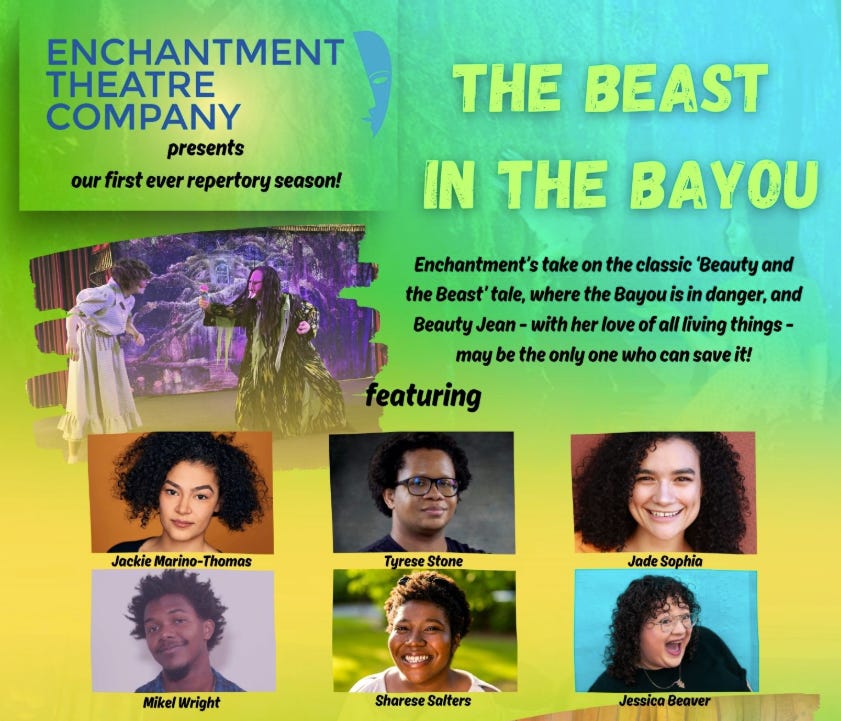
Let me start with the company, because Enchantment Theatre is unlike any other theater organization I know. Founded in Philadelphia in 2000, they describe themselves as “Theatre Beyond Entertainment” - and they mean it. Their mission is to inspire children to dream, explore, think, and connect through imaginative storytelling, and their artistic director’s statement goes even further, positioning the company as heirs to the ancient theatrical tradition of priests and shamans who used masks, music, and illusion to heal and transform. That’s a big claim for a children’s theater company. But having worked with them for a decade, I believe it.
Their signature style combines masked actors, large-scale puppets, magic, and original music to tell stories drawn from classic children’s literature. Every production is an original adaptation. Nothing is licensed. Everything is made from scratch.
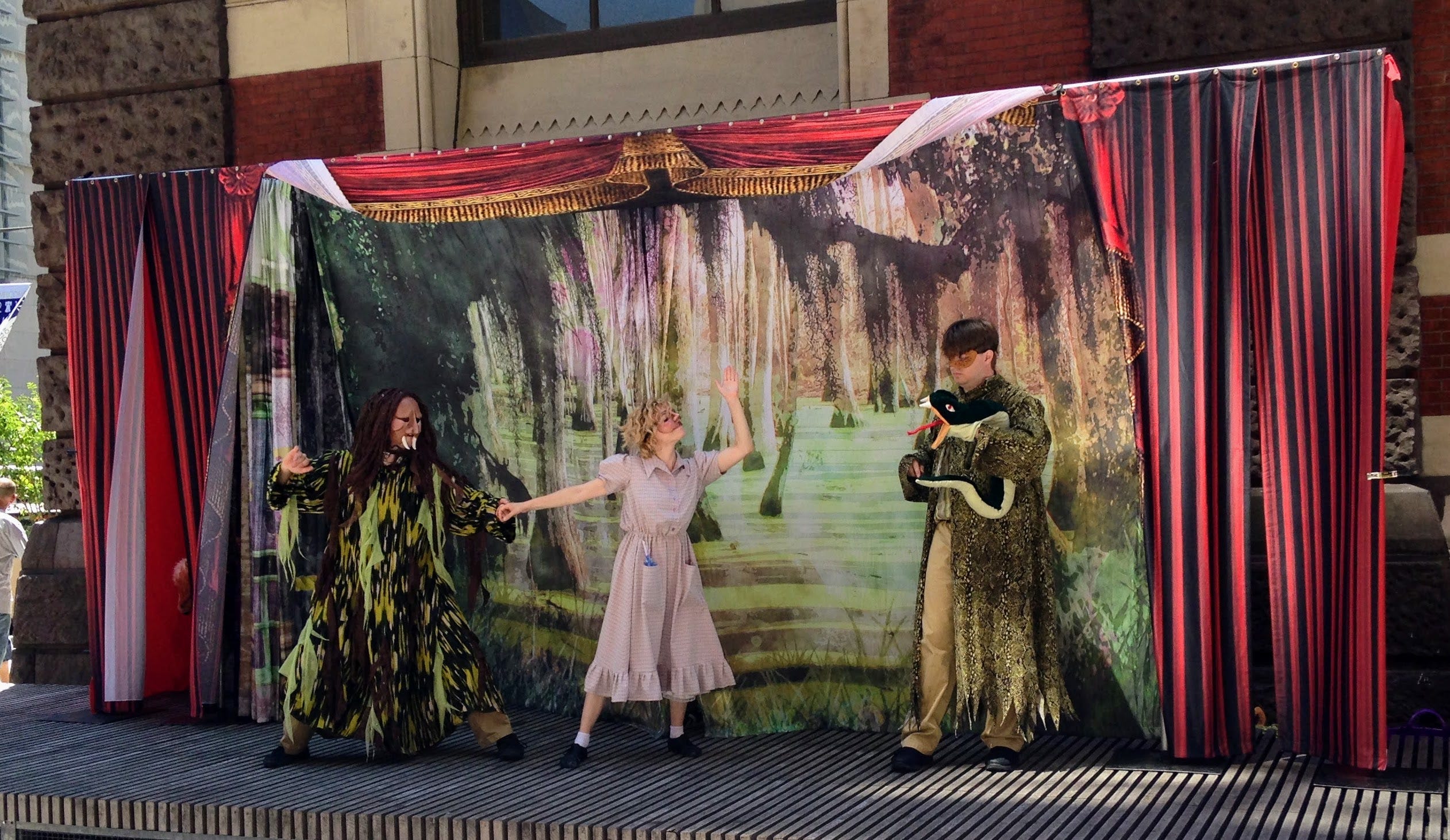
And here’s the part that stops people when I describe it: nobody on stage speaks. Not a word. The actors perform entirely in pantomime - physical storytelling, pure and precise, every gesture intentional. All the narration, all the character voices, all the music come from a single pre-recorded soundtrack playing through the speakers. My wife, singer and actor D’Arcy Webb, performed the narration for Beast in the Bayou - not just the third-person storytelling voice but every character’s voice as well, Odis and Grace and Beauty Jane and the Beast himself, each distinctly characterized. Underneath and around her voice runs the continuous music track I composed - not incidental background music but a complete score, more like a film soundtrack than a theater pit band, shaping every moment of the action.
The effect is something I’ve never quite seen anywhere else in professional theater. It’s not mime - mime eschews narrative entirely. It’s not puppet theater - these are live human actors in full physical commitment. It’s not a musical - nobody sings from the stage. It’s closer, perhaps, to watching a beautifully illustrated book come to life, the storytelling voice in your ear while the pictures move and breathe in front of you.
Philip Pullman, whose quote appears on Enchantment’s website, wrote: “Children need to go to the theatre as much as they need to run about in fresh air. Otherwise they perish on the inside.” Enchantment takes that seriously. What they’ve developed is a theatrical form that delivers genuine transformation - not despite its simplicity, but through it.
Which brings me to the van.
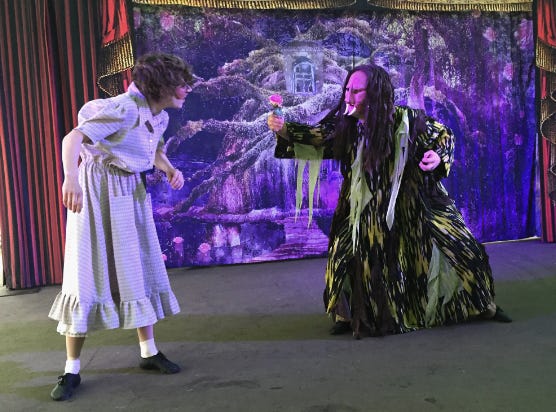
The Beast in the Bayou wasn’t made for a mainstage season. It was created for an initiative Enchantment calls “Enchantment Everywhere” - a stripped-down touring model designed to bring professional theater directly to schools. The entire production - five actors, a stage manager, all the scenery, costumes, props, and puppets - fits into a single van. The company arrives at a school, loads in and sets up in an hour, performs the show for the students, then strikes everything, packs the van, and moves on to the next school. No theater required. No technical infrastructure required. Just a space large enough to hold an audience of children, and a company of artists who know what they’re doing.
This is where the use of a pre-recorded soundtrack stops being just an artistic choice and reveals itself as an elegant practical solution. School gymnasiums and cafeterias don’t have sound systems capable of supporting live vocals. Bringing a live band is out of the question. Microphones and mixing boards require a sound engineer and a setup time the model doesn’t allow. But a single high-quality pre-recorded soundtrack, played through speakers the company brings themselves, solves every one of those problems simultaneously. The narration is always clear. The music is always present. The pacing is always right. Every child in every school hears the same story with the same care and quality, whether the school is in a wealthy suburb or a rural district that hasn’t seen professional theater in years.
That last point is the mission. Enchantment Everywhere exists because the children who most need access to transformative art are least likely to have it. The van goes to them.
What I didn’t fully appreciate at the time - what I’ve only come to understand looking back - is that these constraints didn’t limit what we could make. They told us what to make. The limitations were the instructions.
The piece began around a kitchen table. Literally. Landis and Jennifer Smith - Enchantment’s founders - had gathered their creative team at their home to talk through what this new show might be: director Leslie Reidel, and me. We were friends who trusted each other, colleagues who had made work together before, and the atmosphere was less like a production meeting than like exactly what it was - people who enjoyed each other’s company, thinking out loud together about a story they wanted to tell.
The decision to adapt Beauty and the Beast had already been made. What emerged from those kitchen table conversations was everything else: the Louisiana bayou as the Beast’s world, the shopkeeper Odis and his two daughters Grace and Beauty Jane, and the villain - a land developer named Boss Cash. That last detail got a laugh when it came up. Could we really be that obvious? We decided we could. We were making theater for children, and children understand Boss Cash immediately. They know what it means when a powerful man with money threatens a working family. They know it in their bones.
Jennifer took the lead on developing the script while Landis led the physical production - design, casting, the practical architecture of the show. An ensemble of five actors was brought in for a developmental workshop, and the process that occurred in that room was one I’ve only ever experienced in my work with Enchantment Theatre. Everything was created simultaneously, on its feet, in real time: script, movement, music, props - rough stand-ins we called “do-fers,” objects that stood in for the designed pieces that didn’t exist yet. Scenes were sketched out, tried, adjusted, discarded, rebuilt. At the end of the workshop, everything was recorded on video.
Then we went our separate ways. Jennifer continued refining the script. Landis and the designers began building the world of the piece. And I took the workshop video home and set to work scoring the piece like a film, one I’d become proficient at after scoring several previous Enchantment shows - crafting music that captured the tempo and rhythm of each scene, that landed on key moments of physical business, that gave the story its emotional shape.
We were solving problems. We were doing our jobs. We had no idea what we were making.
So what had we made? Looking back at the archival video, playing through the score, I began to see the piece with fresh eyes - and what I saw surprised me.
We had taken one of the most beloved fairy tales in the Western canon and done something genuinely radical with it. In the traditional Beauty and the Beast, the Beast is cursed because of his own failings - vanity, cruelty - and Beauty’s love breaks the curse, transforming him into a prince. Individual redemption through romantic love. It’s a satisfying story. It’s also a very old one.
In our version, the Beast isn’t cursed. He’s indigenous. He belongs to the bayou the way the herons and turtles and foxes belong to it - completely, inseparably. He isn’t waiting to be transformed into something better. He is what he is, and what he is has its own beauty. The threat to him isn’t a witch’s spell. It’s Boss Cash, a land developer who wants to drain the bayou, pay off the debts of struggling families like Odis Jones’s, and turn a wild living ecosystem into something profitable. When Beauty Jane finally returns to the Beast after too long away, he tells her simply: “I’m dying. Without the bayou.” You can’t save him without saving his world. That’s not a fairy tale logic. That’s an ecological one.
And Boss Cash - well. We weren’t subtle, and I’m not apologetic about it. His name says everything: the alliance of power and money that turns living things into resources and working people into leverage. Children understand him instantly. They may not have the vocabulary for extractive capitalism, but they know a bully who uses money as a weapon. They’ve met him. He shows up in stories because he shows up in life.
The politics were embedded in the songs too, though I didn’t fully recognize it at the time. The piece opens with a narrative ballad - sung by me on the recording, with Chris Farrell strummin’ on the guitar - that establishes the legend of the Beast:
Now, don’t go near the bayou!
The swamp will terrify you,
And the Beast is gonna getcha if you do!
Half a man and half a lizard,
He has powers like a wizard
And you better not let him get his hands on you!
There’s a Beast down in the bayou!
My, oh, my, you had better leave him be!
You may hear him howlin’, you may see him prowlin’,
But he’ll always be a mystery.
That’s the community’s story about the bayou: fear it, avoid it, keep your distance. It’s the voice of people who’ve been taught that wild things are dangerous and that nature is something to be wary of rather than part of.
The piece ends with a different song entirely. “Beautiful” is a waltz - a duet sung by me and the show’s violinist, Sarah Larsen - that plays over the final scene as Beauty Jane and the Beast acknowledge their feelings for each other and dance together:
I’ve never seen anyone as beautiful,
As beautiful as you.
They call you a beast, but you are beautiful
Because of the things that you do.
And with me standing by you,
The bayou will always be new.
It may be a dream, but oh, it’s beautiful
And together we’ll make it come true.
From “don’t go near” to “you are beautiful.” That’s the journey of the piece - from inherited fear to recognized connection, from exploitation to restoration. We weren’t trying to write an ecological manifesto. We were trying to write a love song. But the love song turned out to be about more than two unlikely lovers. It was about what we lose when we let Boss Cash win.
The songs do one more thing worth noting, and it gets at something fundamental about how this score is constructed.
A leitmotif - the term comes from opera, and has been used ever since in musicals and film scores - is a musical theme associated with a character, a place, or an idea, that recurs throughout a work in varied and transformed forms. When we hear it return, we carry everything we’ve previously associated with it into the new moment. It creates a web of musical memory underneath the action - connections and resonances that the audience feels even when they can’t name them. John Williams does it in Star Wars. Sondheim does it throughout his career. Wagner essentially invented it as a formal technique.
It’s built into the bones of this score. The opening song - “Don’t Go Near the Bayou” - is set in a minor key, which is music’s traditional signal for danger and darkness. The Beast is a frightening creature, and the melody reflects that fear. But that same melody returns in the final scene, transformed into the major key, as the company breaks into the celebratory hoedown that closes the piece. Same tune. Different world. The Beast hasn’t changed - but our understanding of him has, and the music marks that transformation precisely.
The “Beautiful” theme works differently. Its melody appears for the first time in the opening minutes of the score - tentative, wordless, playing softly in the underscoring at the exact moment the Beast first sees Beauty Jane in the bayou and watches her, unobserved, with something he doesn’t yet have a name for. We hear that melody again and again over the course of the action, each time accumulating a little more weight, a little more longing. But we never hear it sung - never hear the words that belong to it - until the final scene, when Beauty Jane and the Beast finally acknowledge what they feel and the lyric arrives to complete what the melody has been asking all along. I’ve never seen anyone as beautiful, as beautiful as you.
The audience has been hearing that question for an hour. The song is the answer.
There’s one more piece of this story.
My grandfather was a butcher. He worked in a grocery store for much of his working life, earning his living with his hands - the same hands that gardened, that hunted, that could fix and build and make things work. He was a rough character in the best sense of that phrase: unpolished, direct, rooted in the physical world in ways that I, with my conservatory training and my university degrees, have never quite been. We couldn’t have been more different, the two of us. Different educations, different worlds, different relationships to culture and art and what those words even mean.
But he played the fiddle. Old-time fiddle, the kind that doesn’t need a concert hall or a program note or an audience that knows what it’s listening to. The kind that needs a porch, or a living room, or a family gathered together with nowhere particular to be. He played because music was joy, and joy was the point.
I learned guitar so I could play with him. Not because I had any great aptitude for it, or because it fit into my musical education in any formal way, but because I wanted to be there with him in that music. I wanted to be part of what he made. Those family gatherings, the two of us playing together - him on fiddle, me trying to keep up on guitar - are among the most purely happy memories of my life. We were worlds apart and completely together, and music was the bridge.
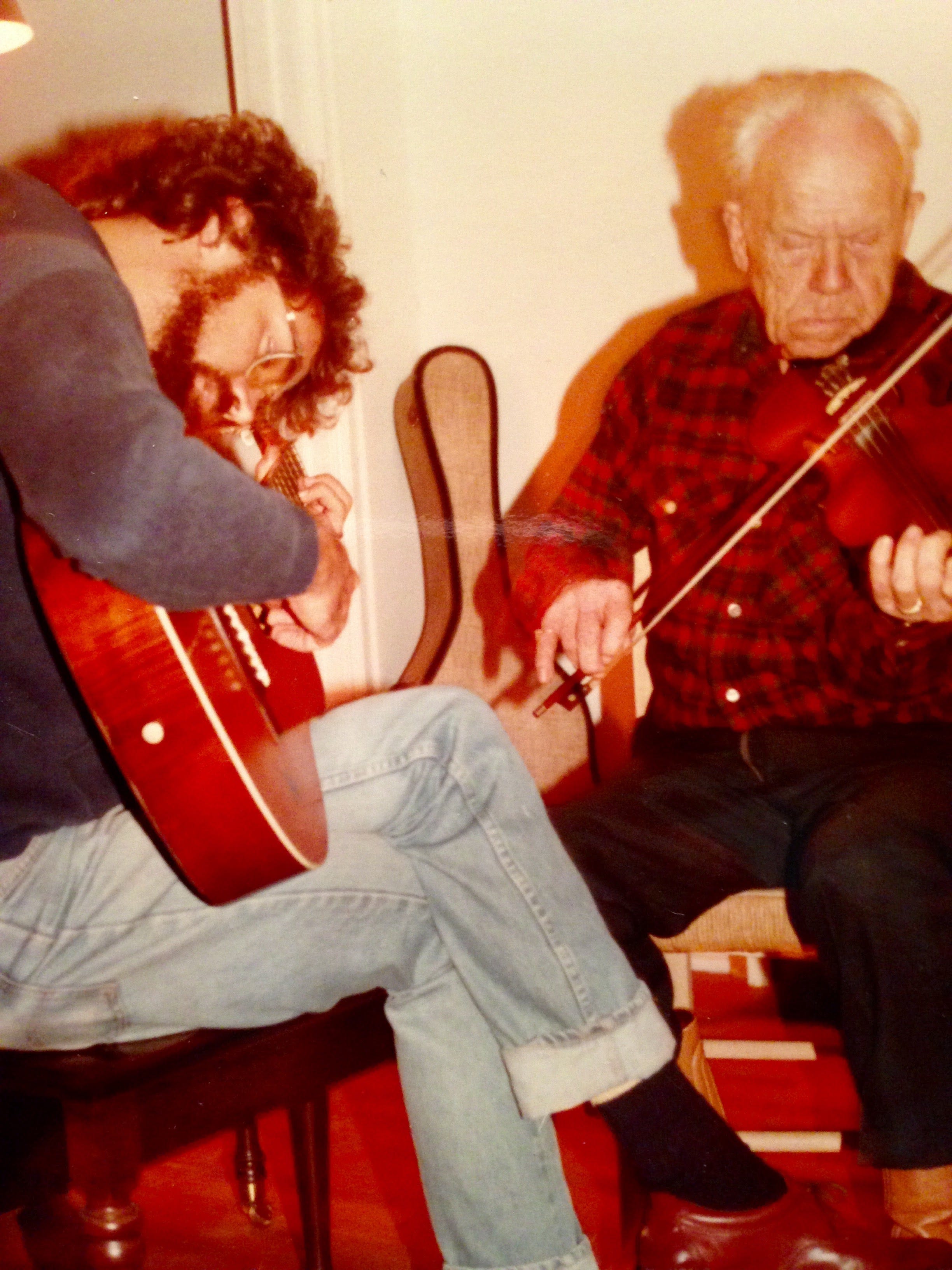
He wrote tunes. Not compositions in any formal sense - he couldn’t have told you what key he was playing in - but melodies that came from wherever melodies come from in people who have music in them and no training to get in the way. One of those tunes he called “Georgie’s Tune.”
It’s in the score of The Beast in the Bayou.
At the very end of the piece, when Beauty Jane and the Beast have finally acknowledged their love, when the bayou has been restored and Boss Cash has been routed, when all the creatures of the swamp - the heron, the turtle, the fox - join the celebration, the company breaks into a final dance. It’s the moment of pure joy that the whole piece has been working toward. And the melody that carries it, that lifts the dancers and sends the audience home with something bright in their chests, is my grandfather’s tune.
I put it there quietly, without announcement. It’s an easter egg - the audience doesn’t know, most of my collaborators didn’t know. But I knew. And knowing it was there changed what the piece meant to me, in ways I’m only now finding words for.
Because here’s what I understand looking back: the rough character and the Beast are kin. The working man who earned his living as a butcher and the creature who belongs to the bayou the way the trees belong to it - both of them outside polite society, both of them possessed of a beauty that takes a certain kind of seeing to recognize. The fiddle music that connected a formally educated composer to his unschooled grandfather is the same music that closes the distance between a girl in overalls and the most unlikely of loves.
I didn’t know I was writing about my grandfather when I wrote this piece. I was solving problems with friends. But the music knew. It always knows.
This spring, a new company of five actors will load The Beast in the Bayou into a van and take it to schools. They weren’t part of the original production - they weren’t in the room at the kitchen table or in the developmental workshop where the piece found its shape. But they have what they need: the sets, the props, the costumes, the puppets, and a reference video of the original production that will serve as their guide. Leslie Reidel, who directed the original, will teach it to them. It’s not unlike the way a ballet company remounts a repertory piece - the choreography exists independently of the dancers who first performed it, and the work of the rehearsal room is to inhabit something already made rather than to invent something new.
And my voice will be in the room with them. D’Arcy’s voice will be in the room. Sarah Larsen’s fiddle and Chris Farrell’s guitar will be in the room. The recording travels with the piece the way a score travels with a symphony - fixed, complete, waiting to be brought to life by the performers who move inside it. New actors, new bodies, new interpretations of the physical life of the piece. But the same story. The same music. The same Georgie’s Tune carrying everyone home at the end.
I find something unexpectedly moving about that. We made this piece ten years ago, around a kitchen table, in a workshop room, in a home studio where I sat with my video and my GarageBand and tried to give the story its musical shape. We were solving problems. We were enjoying each other’s company. We were doing our jobs. And what we made has outlasted the moment of its making. This piece has traveled to schools all over the Philadelphia region, has been seen by children who are now ten years older and carry something from it that they may not even be able to name. That’s what theater does when it works. It goes somewhere in you and stays.
So was it as good as I remember? That was the question I started with. But sitting with the archival video, playing through the score, reading the script again after all these years, I understood that it was the wrong question. The right question - the one that this re-examination actually answered - was something more like: did we know what we were doing?
And the answer, I now understand, is: not entirely. Not consciously. We knew we were adapting a fairy tale for children in a van. We knew we were serving Enchantment’s mission of bringing theater everywhere it was needed. We knew we were working within constraints that were also instructions. What we didn’t fully know - what I couldn’t have articulated at the time - was that we were making something about the value of wild things and the cost of destroying them. About working people and the forces that exploit them. About the beauty that exists in rough characters and unlikely lovers and ecosystems that don’t show their grace to everyone. About a girl in overalls who chooses the bayou over the comfortable life. About what it means to say: it was you. It was always me.
And we didn’t know - I didn’t know - that at the center of it all, carrying the final dance, was my grandfather’s tune. That a butcher’s fiddle melody would end up in a professional theater piece touring to elementary schools, celebrating the union of the most unlikely of loves, making the argument in the only language that doesn’t require translation that enchantment is real, that it’s everywhere, and that it belongs to everyone.
That’s what the re-examination gave me. Not reassurance that the piece holds up - though I believe it does - but the understanding of what it was always about. The work knew things the makers didn’t. The constraints told the truth. The camaraderie produced something that none of us could have made alone, and that none of us fully understood until now.
Enchantment everywhere. Including here. Including now. Including in the schools where five new actors will carry it this spring, and the children who will watch it, and the grandfather’s tune that will send them home.
Divine!
It was such an honor to perform this in past years - loved reading thing and learning how your grandfather's music is woven through the fabric of the piece, and to know how it all started ❤️