"Here I Am"
Returning to where my teaching journey began

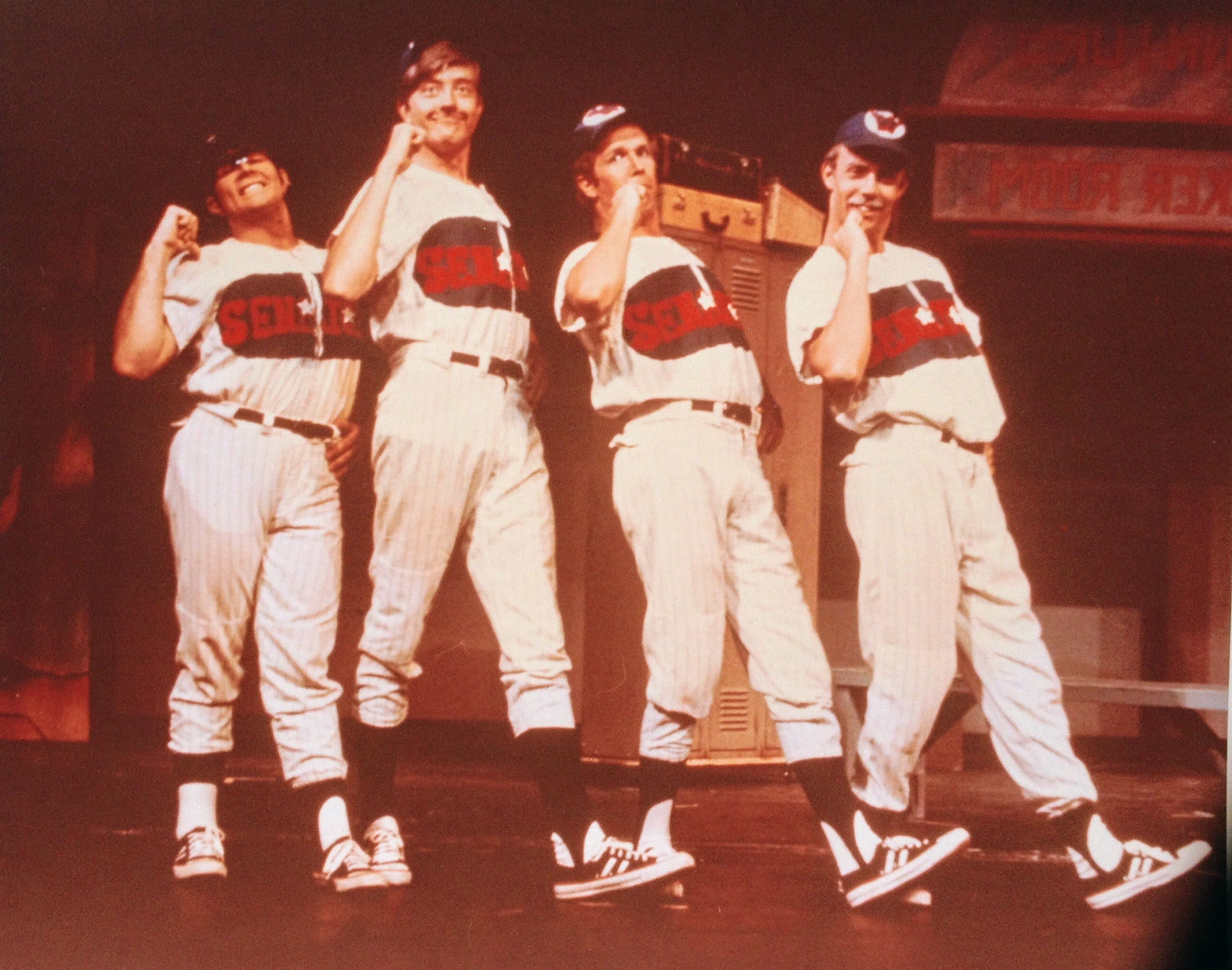
My story begins with this photograph from 1974: four young men in pretend baseball uniforms, standing on the stage of Mitchell Hall at the University of Delaware, all in identical poses - a classic choreographed musical theater tableau. The stage lights cast a warm glow. You can see the commitment in the faces, the unselfconscious joy of being twenty years old and getting paid summer stock wages to perform Damn Yankees and make the customers happy.
That’s me on the right, playing Van Buren, the manager. We’re singing “You Gotta Have Heart” - which seems, half a century later, almost too appropriate. Grinning David is on the far left, beanpole Ron is next to him, then handsome Dana, all of us great friends then and over seventy years old now, except for Ron, who’s gone.
On February 2, 2026 - more than fifty years after this photo was taken, and just a few days from now - I’ll walk back into a classroom at that same university to teach a course called Foundations of Singing Acting, and address the mysteries of musical theater performance with a new generation of aspiring Broadway babies like the lads in this photo.
We had heart back then, “miles and miles and miles of heart,” like the song says. What we didn’t have was much in the way of craft. We had enthusiasm, commitment, the infectious energy of young people who loved musical theater and were willing to throw themselves into it. What we didn’t have was a systematic understanding of what made singing acting work - why some moments landed and others fell flat, why some performances grabbed an audience and others left them checking their watches.
I loved musical theater as an undergrad, and it became the focus of my studies. (Follow the link to read my earlier essay about seminal experiences from my freshman year.) I designed my own major - theater and music courses with a handful of keystone practicum projects - under the auspices of what they called the Dean’s Scholar program. During my years at UD, I started to figure out my place in the ecosystem wasn’t so much on the stage as it was on the sidelines - directing, writing, creating new work and, in a turn of events that surprised me, teaching others how to do it.
I completed an MFA in Directing at Carnegie Mellon University. I spent a year working for Theater Express, a small company in Pittsburgh that produced a crazy-ass musical I wrote called Assassins that would turn out to play an important role in my journey, though I didn’t know that yet. And I kept in touch with a couple of my professors from UD, who apparently saw promise in the precocious, sometimes obnoxious undergrad who’d been their student. In 1979, they hired me for a position teaching and directing musicals at my alma mater.
I was twenty-four years old.
I was back in the same building where I’d performed in Damn Yankees, but now I was the one standing at the front of the studio. My first “musical theater performance” class was a motley crew of singers who wanted to act and actors who wanted to sing - some theater majors, some music majors, some just Broadway-curious but all hungry to figure out how to do this thing we call singing acting.
The problem was, I didn’t really know how to teach it.
This was 1979. There was no established pedagogy for musical theater training. Actors studied Stanislavski or Meisner or Uta Hagen. Singers worked on bel canto technique and art song. Dancers trained at the ballet barre. But singing acting - the specific challenge of creating truthful, moment-to-moment behavior while executing the highly organized demands of a musical score - that was territory without a map.
So I did what I knew how to do: I brought my director’s toolkit into the studio. I gave notes. Detailed instructions. “Try it softer here.” “Look away on that phrase.” “Make a bigger gesture.” Every class became a kind of master class, a rehearsal room experience. Sometimes the results were exhilarating - a student would take a note and suddenly the whole song would come alive. But it always seemed slow and hit-or-miss. I was doing too much of the students’ work for them.
You know that adage about teaching a man to fish versus giving him a fish? I was dispensing fish left and right, and it was profoundly inefficient. I sensed that what I needed was something more fundamental - basic principles, precepts like Stanislavski’s I could teach that would give students artistic autonomy and agency in their own growth. Something they could take with them into the practice room and the rehearsal room when I wasn’t there.
This became even clearer when I moved to Syracuse University after six years of teaching at UD. The students there were more talented, more ambitious. BFA programs are full of kids who’ve been selected by audition to make a compatible, competitive cohort. There were so many songs, so much ambition, and so little time. I needed a system.
It was during my year at Syracuse that I discovered The Complete Singer-Actor, written by H. Wesley Balk and first published in 1977. Balk’s book was subtitled Training for Music Theater, and it included a pedagogical framework and pages and pages of descriptions of exercises that blew my mind. This was just what I was looking for - a way to train the skills of singing acting, not just coach individual performances.
I recognized in Wesley Balk a kindred spirit - an experimenter who was both analytical and playful in his approach. As he contemplated the expressive power of music theater, his prose often grew lofty: “Song is the most compelling way of seducing the word away from its concern with an ungenerous reality to a more deeply felt ideality,” he wrote. “To have the best of both worlds, to combine the clarity of reason with the turbulence of feeling, is to sing.” His ideas about the integration of opposites - singing and acting, thought and feeling, structure and freedom - became a touchstone for me as well.
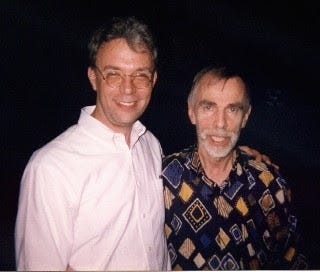
I made it a point to seek out this sage and eventually had a chance to observe him teach at the Manhattan School of Music. Watching him work was a revelation. He had singers doing exercises that isolated specific aspects of performance - focus work, breath work, gesture work - building their capacity to create behavior intentionally and playfully. The terminology in Wes’s teaching was opera-centric and needed some adapting so that the Broadway wanna-bes wouldn’t be put off by it, but discovering his work proved to be the turning point in my development as an aspiring pedagogue.
I finally had a fishing rod. Now I needed to learn how to use it.
I spent only a year at Syracuse, but the skills, knowledge, and experience I gained from that year stood me in good stead when, a few years later, I got the opportunity to help start a new musical theater program at the University of the Arts in Philadelphia. At UArts, I was given a blank slate - a chance to develop a four-year curriculum that reflected my vision of how young musical theater artists should be trained.
One by one, we brought in new faculty in voice and dance to supplement the teachers in UArts’s young School of Theater Arts. I was even able to bring Wesley Balk to UArts as a guest teacher to work with my undergraduate musical theater students. Wes was slowing down by this time, and there was unmistakable evidence that Parkinson’s was taking its toll on him, but he was a charismatic, articulate master teacher and my students and I hung on his every word - amplified by the portable sound system he had to bring along to project his whispering voice. We partnered with the Prince Music Theater, a Philly institution with an international reputation, on the development of new musicals, with my students working side by side with professionals like Adam Guettel, Tina Landau, and Ricky Ian Gordon. As word spread and our reputation grew, the program became one of the most popular at UArts, and we had our pick from a talented pool of applicants.
And in the studio, semester after semester, I kept refining my approach. I adapted Balk’s exercises. I invented new ones. I watched what worked and what didn’t. I listened to students describe their breakthrough moments and tried to figure out what had made those moments possible. What were the common denominators in effective singing acting? What could be trained? What could be named?
Slowly, over years of trial and error, patterns began to emerge. Four qualities showed up again and again in performances that worked, that grabbed an audience and held them. I started talking about them explicitly with students: Variety. Intensity. Specificity. Authenticity. These were the attributes of effective singing acting, the elements you could identify in great performances and notice the absence of in ones that fell flat.
I decided I needed a name for my system. An acronym would be memorable, easy for students to internalize. Thinking about those four attributes of effective singing acting - Variety, Intensity, Specificity, Authenticity - I hit on the acronym VISA. Perfect! And the pasteboard “catalyst cards” I’d been experimenting with in class - cards with pictures or words that served as behavioral prompts - would be called VISA Cards. Of course!
Except no. Because someone else had already trademarked the term “VISA card.” Womp womp.
But what if I rearranged the letters? Specificity, Authenticity, Variety, Intensity. SAVI. It even sounded like “savvy” - street smarts, practical knowledge, exactly what I was trying to cultivate in young performers. The SAVI System. SAVI Cards. I became the SAVI Savant, and it became my calling card.
The book took a long time. Along the way, there were presentations at conferences - in Germany, the UK, Scandinavia. I helped to found the Musical Theater Educators Alliance, an international consortium of teachers and schools who shared my passion for musical theater training, and my MTEA colleagues provided a valuable sounding board for my emerging scholarship. I taught SAVI workshops in Oslo and Perth, Liverpool and Orlando, and even in summer camps in the Philly suburbs. Everywhere I went, people asked: “When’s the book coming out?”
Soon, I’d say. Soon. I’ll get around to writing it soon.
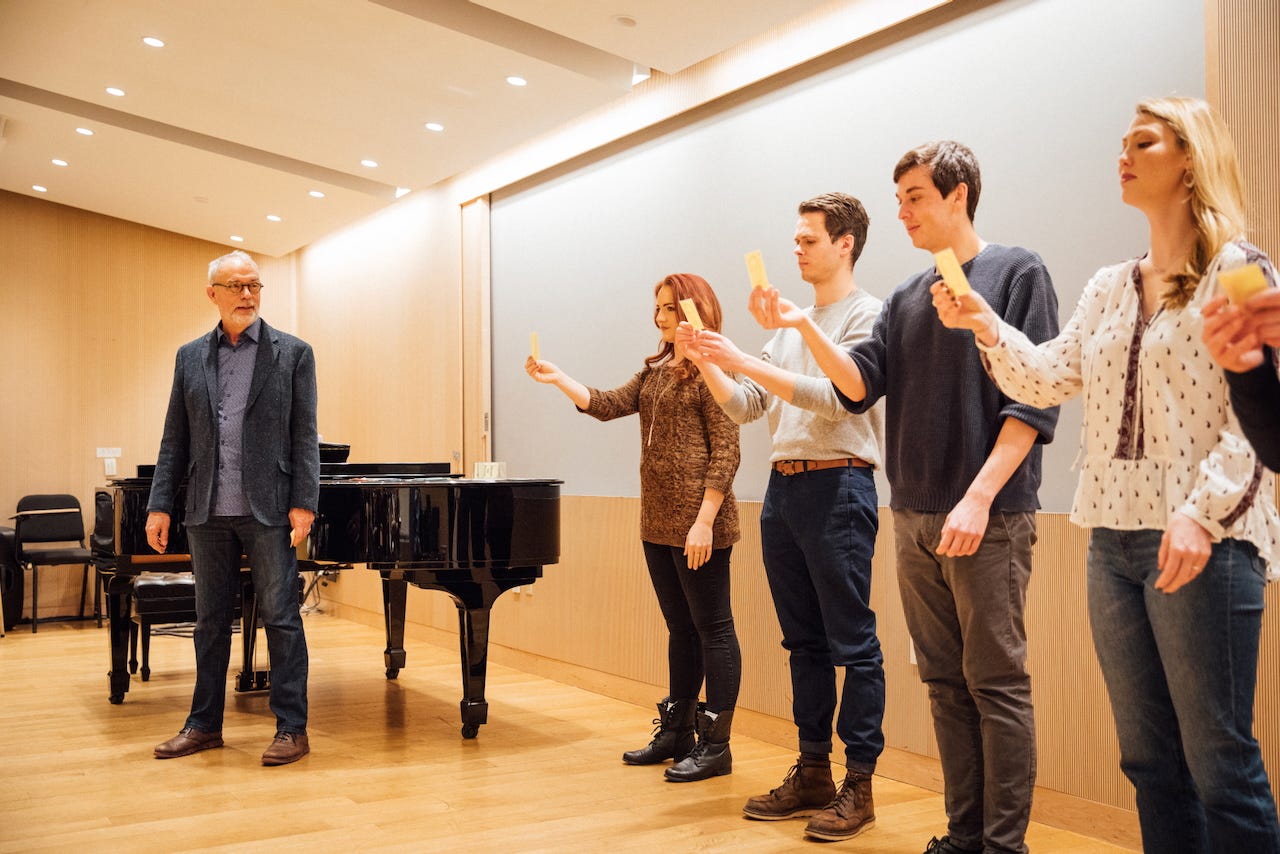
I completed a draft by 2018, and a group of students that year - they called themselves the SAVI Soldiers - agreed to serve as guinea pigs for a class where we read and discussed the manuscript and worked through the exercises in a systematic way. This intrepid platoon proved to be an invaluable sounding board, and their feedback helped me prepare the final draft. I hired a graphic designer to finalize the look of the SAVI Cards, used some of my students as photo models for the picture cards, and brought in an editor to give my text a final polish.
When the book was published in 2019, I launched it at the International Thespian Festival in Lincoln, Nebraska. I taught workshops and sold books and SAVI Cards. And while it wasn’t a wildfire success (follow the link below to read my essay “The Books In My Basement” for more details), the SAVI pedagogy began to catch on, and continues to spread even now.
My thirty years at UArts were an unforgettable journey, but my final years there proved to be anticlimactic. With changes in leadership and departmental politics, I found myself sidelined and undervalued by the institution I’d helped to build. I was returning home from a SAVI demonstration at SETC in Louisville at the end of March 2020 when COVID shut down UArts, like everything else in the world. I did my best to teach online for a semester, but I was old enough to retire now and I was ready to move on.
In the years since UArts, I taught SAVI at Drexel University as an adjunct and pursued a range of creative projects, one of which eventually led me to the University of Delaware’s Resident Ensemble Players, where I was hired as a guest artist to appear as an onstage pianist in Tom Stoppard’s Rough Crossing. One day, while on a break from rehearsal, I handed Steve Tague - then the chairman of the Theater and Dance Department and the artistic director of the REP - a copy of The SAVI Singing Actor and said, “If you’re ever interested in offering a musical theater class for undergrads, check this out and let me know.”
And he did.
Steve reached out about a year later. Would I be interested in teaching a course called Foundations of Singing Acting? Starting in Spring 2026?
I said yes before I’d fully processed what I was agreeing to. Then it hit me: I’d be returning to teach at the university where I’d done my undergraduate degree more than fifty years ago. Where I’d played Van Buren in Damn Yankees and figured out I wanted to be a director and creator of new work. Where I’d returned in my twenties to teach my first musical theater performance class, fumbling toward something I didn’t yet have language for.
Now I’m seventy years old. I have the language. I have the system. I have the book, the cards, five decades of trial and error distilled into a pedagogy that I know works because I’ve seen it transform hundreds of students.
And I’m profoundly moved by the circularity of it all, the sense that I’m completing something I didn’t know I’d started.
In February, I’ll walk into a classroom at the University of Delaware - a room where I took movement classes as an undergrad - and one of the first exercises we’ll do is an etude called “Here I Am.”
It’s described on pages 35-41 of the book, and it’s deceptively simple. Students stand in a circle and sing a short musical phrase over and over: “Here I am.” The melody consists of just three pitches arranged in a two-measure phrase. But the exercise isn’t about the notes. It’s about being fully sentient, present in the moment. Acknowledging your actual environment and how you feel in that environment. Bringing your authentic self to the present moment.
“Here I am, right here, in this particular room at this particular moment, feeling these feelings I am feeling right now.”
Each time you sing the phrase, you take a breath, reawaken your senses, shift your gaze. The words are the same, but the moment has changed because you’ve changed. You’ve moved. You’re not in the same place you were.
Here I am in 1974, twenty years old, singing “You Gotta Have Heart” with David and Ron and Dana, all of us in our baseball uniforms, all enthusiasm and no technique.
Here I am in 1979, twenty-four years old, standing in front of my first class at UD, trying to teach something I don’t yet understand.
Here I am in 1986, discovering Wesley Balk’s book at Syracuse, finding my fishing rod.
Here I am building a program at UArts, refining exercises, watching patterns emerge, year after year after year.
Here I am finally writing it down, naming it, publishing it, sending it out into the world.
Here I am in 2026, seventy years old, walking back into a UD classroom to teach SAVI where it all began.
The exercise teaches students that each phrase is its own unique opportunity to create behavior - that you must assess what just happened and adjust accordingly. That’s the AAA Cycle: Action, Assessment, Adjustment. That’s how singing acting works. That’s how life works.
When I sing “Here I am” in that classroom at UD, I’ll be aware of something those four young men in the Damn Yankees photo couldn’t have known: that every moment is both familiar and new, that you bring your whole history with you into each present moment, that “here” is never quite the same place twice.
We had heart back then, miles and miles of heart. Now I’m bringing the heart back home, along with everything I’ve learned about how to channel it, shape it, make it specific and authentic and varied and intense. How to make it SAVI.
Here I am.